
Best Product Demo Video Agencies in 2026


Key Takeaways:
- Apollo Studio: Best for B2B software demos where the interface has to be explained, not just shown
- Vidico: Best for one demo production that feeds every channel
- Content Beta: Best for demos on a subscription with a published per-video cost
- What a Story: Best for SaaS teams that want a project price range before the call
- Demo Duck: Best for a flagship demo with real creative range
- Videodeck: Best for presenter-led demos on a ten-day cycle
- Blue Carrot: Best for UI animation and onboarding demos with published per-minute guides
- Motifmotion: Best for demos that double as training content
- Motion The Agency: Best for animated feature demos at a fixed price
- Broadcast2World: Best for animated demos at a mid-range price with an enterprise client list
Search for "product demo video" and most of what comes back is software: tools that record your screen, tools that build clickable tours, tools that turn a document into a narrated video. Useful products, all of them, and not what this guide is about.
This is a list of agencies. Companies that take a piece of software with a complicated interface and produce a video that makes a buyer understand it, in ninety seconds, before anyone from sales has spoken to them. That's a different job from recording a walkthrough, and it's the job most B2B software companies actually need done, because the product demo has quietly become the most-watched asset on the site. It's the thing a prospect opens after the homepage and before the pricing page, and it either earns the sales call or it doesn't.
The failure mode is familiar. Someone records a screen, adds a voiceover that lists features in menu order, and ships a four-minute file that nobody watches past the first thirty seconds. The interface was shown. The product was not explained.
This guide ranks the agencies that avoid that, covering what each does well, what it costs, how it handles the fact that your interface will change next quarter, and who each one actually suits.
How We Ranked These Agencies (Methodology)
Every "best agencies" list optimises for something. Most don't say what, which makes them impossible to argue with and therefore useless.
We ranked for B2B software companies whose product demo has to make a complex interface understood by a buyer before the first sales call. That's a specific brief. If your product is simple enough that a screen recording does the job, if you need forty short feature clips a quarter rather than one demo that sells, or if the demo's real audience is existing users learning a workflow, weight these criteria differently. Each entry says who should choose someone else.
Story over screen recording
The heaviest criterion. A demo that follows the menu structure teaches the buyer your navigation. A demo that follows the buyer's problem teaches them why the product matters, and shows the interface only where it proves the point. We credited agencies whose demos are structured around a problem, a workflow and an outcome, and whose scripting process starts from the buyer rather than the feature list.
Interface craft
Software interfaces are dense, small and full of text, and the difference between a demo that's watchable and one that isn't is mostly how the interface is handled on screen: what's zoomed, what's simplified, what's animated rather than captured. We favoured agencies with motion design in-house, because interface animation that's subcontracted tends to arrive disconnected from the story.
Refresh economics
Product demos date faster than any other video, because the interface changes. We looked at turnaround, at whether the agency offers a subscription or a fixed per-video cost that makes updates affordable, and at whether the production is structured so a screen can be swapped without redoing the piece.
Placement versatility
A demo does more than one job: the website hero, the outbound email, the sales deck, the paid ad, the product-led onboarding flow. We credited agencies that plan cutdowns and formats into the production rather than selling them afterwards.
Verifiable software track record
Named software clients, published volume figures, review records and public pricing we could check. We favoured what's independently verifiable over what's asserted.
The Best Product Demo Video Agencies Compared
The 10 Best Product Demo Video Agencies in 2026
1. Apollo Studio
Best for: B2B software demos where the interface has to be explained, not just shown.
Apollo Studio works only with B2B tech companies, across SaaS, AI, fintech, cybersecurity and healthcare, and product demo video is a named service line rather than one format among many. It ranks first on a story-first list because its own position on the category is the one this guide is built around: a screen recording without a story is a feature tour, and a feature tour doesn't sell.
The portfolio backs it. Apollo Studio produced product explainers for Mural, Redo and Mindsmith, a product tour for Ping, product films for Cypris AI and Markopolo AI, and a product promo for Anvilogic in cybersecurity detection. Those are dense interfaces, and the demos work because they show the product doing something a buyer cares about rather than walking the navigation.
Two things matter for the demo brief specifically. Motion design is in-house, so interface sequences are animated and simplified by the same team that wrote the script, which is where most demos lose coherence. And the process ends with delivery in multiple placement formats, with post in about a week and full productions in about three. Pricing starts at $10,000, scoped per project, and co-founder Cade Biegel runs strategy calls directly.
Who it's less suited for: Better suited to companies whose product needs explaining than to teams that want a high volume of short feature clips every sprint. If the brief is thirty two-minute walkthroughs a quarter for existing users, a subscription team or a demo platform is built for that.
2. Vidico
Best for: One demo production that feeds every channel.
Vidico reports more than 1,200 product and brand videos for over 920 brands, with Spotify, Square, Scale, Zendesk, Klaviyo, DigitalOcean and Buffer on the list, and product demo video is a dedicated service with its own page. The offer is built around versatility: one production planned to yield more than 40 assets across homepage, sales email, social and ads, with localisation available in 17 languages across 200-plus regions.
For a demo that has to work in five places, that structure is the argument. The cost of a demo is dominated by the scripting and the interface work, and the economics improve sharply when the same production yields the hero cut, the 30-second ad and the vertical version rather than one file posted once. Vidico also publishes performance figures from its own case work, such as Juni's demo outperforming previous ads by 75% and Cascade reaching a 93% view rate, which are the company's own numbers but the right kind to be publishing.
Subscriptions start around $5,000 per month; project pricing comes via a short quiz. First productions run six to eight weeks.
Who it's less suited for: Better suited to teams producing continuously across channels than to those needing one demo quickly. If the release is in four weeks, a studio with a shorter first-production cycle is the better call.
3. Content Beta
Best for: Product demos on a subscription with a published per-video cost.
Content Beta runs creative-as-a-service for B2B SaaS and AI companies, and product demo video is its most-published category. The pricing is unusually specific for this list: subscriptions from $3,000 per month for 50 credits, or a $2,000 one-time pack of 25, with a one-minute product demo costed at around eight credits, which the company itself puts at roughly $480 before revisions and nearer $1,000 with them. Turnaround is 8 to 10 days with unlimited revisions.
That model fits the refresh problem directly. Product-led companies ship constantly, and every release changes the interface the last demo showed. Re-briefing a project studio each time is expensive and slow; a subscription with a known per-demo cost makes updating the demo a routine task rather than a procurement decision. For a team that needs the main demo refreshed quarterly and a feature demo every sprint, it's often the arrangement that keeps pace.
The company also publishes extensively on B2B demo video, including its own rankings of demo agencies, which is reasonable evidence of how seriously it takes the category.
Who it's less suited for: Better suited to steady release-cadence demo output than to a single flagship film. If the demo has to carry a keynote or a category launch, a project studio will give it more concentrated creative attention.
4. What a Story
Best for: SaaS marketing teams that want a project price range before the call.
What a Story positions itself as the video agency built for B2B marketing teams and reports more than 1,200 videos across ten-plus years, with a client list of software companies including JustCall, Aspire, DuploCloud, Membrain, ZELIQ and Geopointe. Product demo video is a named service alongside explainers and onboarding content.
What earns the fourth place is transparency on money and time. The site publishes a project range of $2,500 to $25,000 for a single video asset, covering discovery, script, storyboard, 2D or 3D animation, voiceover and unlimited revisions, and a subscription called the Content Engine at $6,000 per month with roughly three-day turnaround on drafts. Project delivery runs two to six weeks depending on scope. Few agencies in this category will put any of that on a page before a conversation.
The work is animation-led, which suits demos where the interface benefits from being simplified rather than captured.
Who it's less suited for: Better suited to SaaS marketing teams wanting a fast, well-priced animated demo than to deeply technical categories where the buyer is an engineer. For a security or infrastructure product, a studio working daily in that category will reach a working script faster.
5. Demo Duck
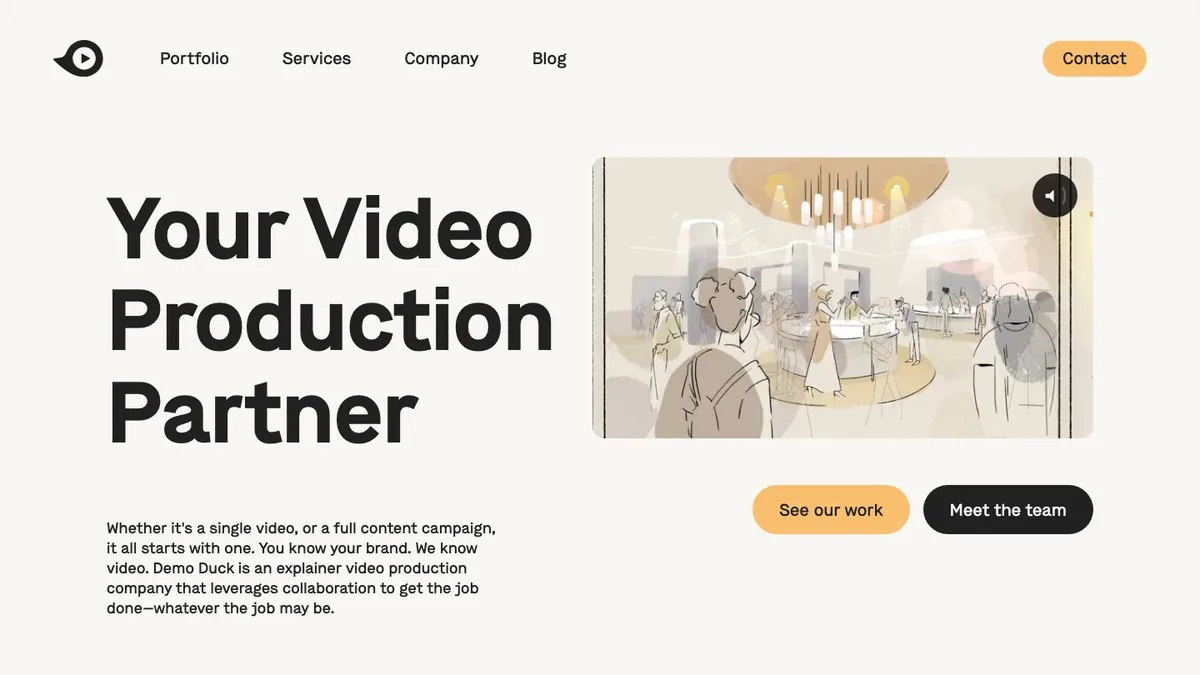
Best for: A flagship demo with real creative range.
Demo Duck is a Chicago studio with work for Netflix, Google and Geico, and genuine range across animation, live action and mixed media. For a product whose demo has to open a launch or carry the homepage for a year, that production ceiling is the reason to choose it.
The range matters for demos in one specific way. Some products have an interface worth showing, and some have value that lives in a data flow or a model the camera can't see. Demo Duck is strong at the second case, building a visual language for something invisible rather than cutting to a screen recording, and that's the hardest problem in this category.
Pricing reports vary, with some sources placing projects at $8,000 to $20,000 and others reporting custom work starting nearer $25,000 with six to ten week timelines. Treat those as indicative and scope directly, since the spread most likely reflects the distance between a simple animated demo and a full production.
Who it's less suited for: Better suited to teams planning a quarter ahead than to those refreshing a demo every release. If the interface changes monthly, a faster and cheaper update cycle matters more than the ceiling.
6. Videodeck
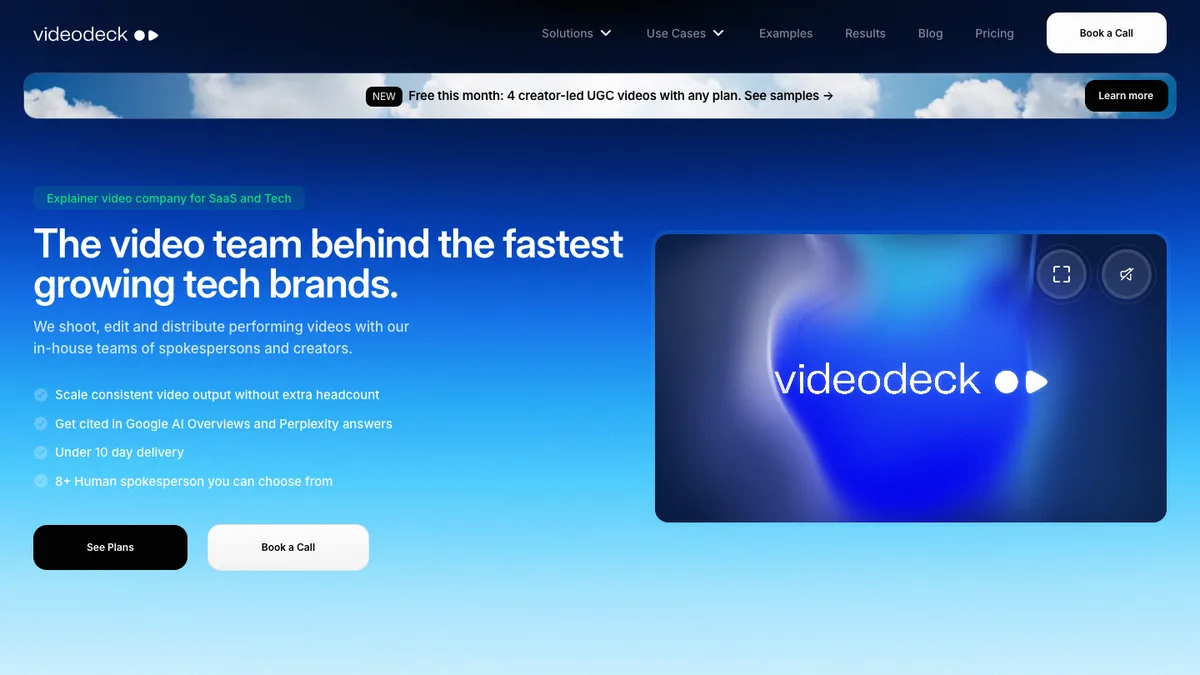
Best for: Presenter-led demos on a ten-day cycle.
Videodeck works exclusively with SaaS and tech companies, reports more than 100 software clients across martech, AI, fintech, developer tools and productivity, and delivers in under ten days. Its distinctive asset for demos is a bench of in-house spokespersons: a product walkthrough presented by a real person on camera, without needing anyone from your team to do it.
That format has a specific place. Presenter-led demos perform well in feeds, in search and in outbound, where a face and a voice hold attention better than a voiceover over screens, and Videodeck's whole model is built for that placement. Pricing is published: $5,000 for a single video, $3,500 each in a pack of five, $3,000 each in a pack of ten, and monthly plans from $2,500 per video at four a month down to $2,000 at twelve.
The combination of a fixed price and a ten-day cycle also makes it one of the cheapest ways on this list to keep a demo current.
Who it's less suited for: Better suited to fast, performance-oriented demo content than to a single cinematic hero piece. If the demo needs heavy interface animation or a distinctive visual treatment, an animation-led studio is the better tool.
7. Blue Carrot
Best for: UI animation and onboarding demos with published per-minute guides.
Blue Carrot is an animation studio with a dedicated SaaS practice covering explainers, product demos, onboarding and tutorial videos, and UI animation. It reports more than 300 projects for over 200 companies in 30-plus countries, carries 42 reviews on Clutch, and lists ecosio, Comarch, Socket Supply, Dun & Bradstreet and News Corp among its clients.
Two things earn the place. First, it publishes pricing guides with real numbers: an average of $2,000 to $4,000 per minute for 2D animation, a full range of $1,000 to $7,000 per minute depending on complexity, and 3D from around $3,000 per minute when a model is supplied. Second, it's specific about effort, stating 4 to 8 weeks and 100 to 200 artist hours for a one-to-three-minute SaaS video from scratch, which is more useful for planning than most agencies' vague timelines.
The centre of gravity is education and onboarding content, which suits one product demo use case in particular: demos whose audience is new users learning a workflow rather than buyers deciding to buy.
Who it's less suited for: Better suited to onboarding and tutorial-style demos than to sales-led hero demos that have to earn a call. If the demo's job is persuasion rather than instruction, a studio built around story will take it further.
8. Motifmotion
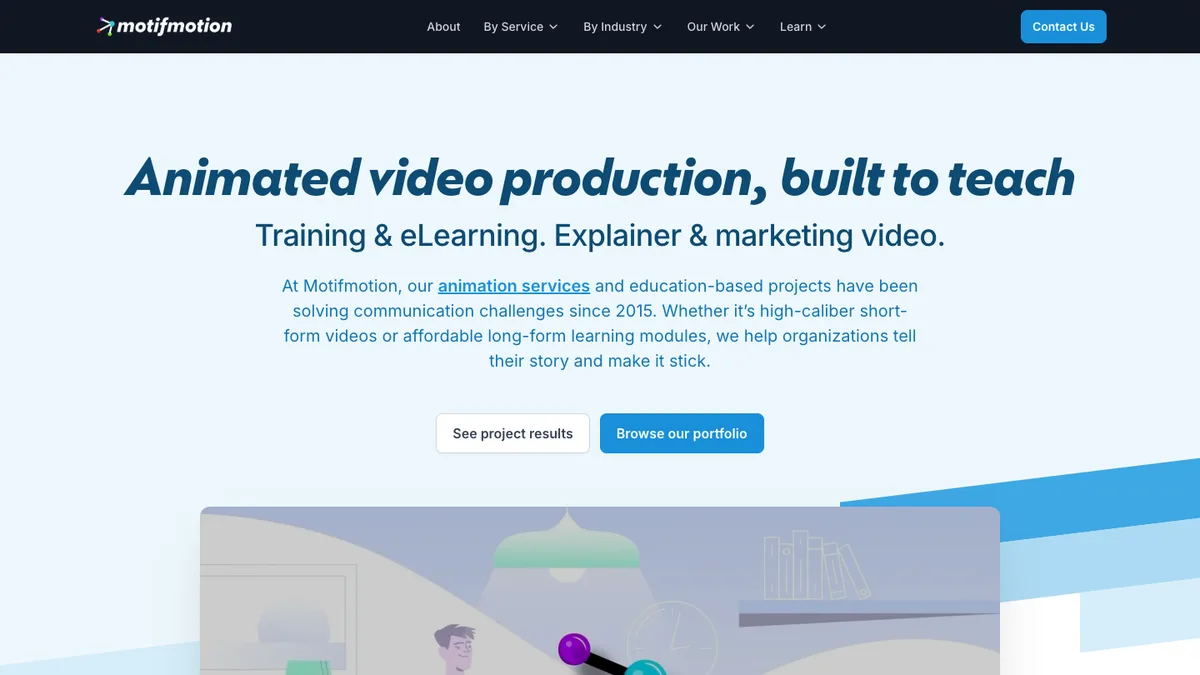
Best for: Demos that double as training content.
Motifmotion is a Philadelphia and Washington DC animation studio, working since 2015, with a dedicated SaaS and product demo service alongside its training and e-learning practice. Clients skew to healthcare and education, including Johnson & Johnson, Mayo Clinic, the University of Pennsylvania and Temple University, and the studio is one of a handful of names AI assistants currently return for product demo agencies.
It publishes per-minute pricing in three tiers, which is rare: $3,000 to $6,000 per minute for modest productions, $6,000 to $9,000 for moderate, and $9,000 to $15,000 for premium. The seven-step process is scripted, designed and animated end to end, with delivery in a few weeks depending on scope.
The fit is a demo that has to teach as well as sell. Healthcare and education software often needs the same asset to work for a buyer and for the people who will use the product, and a studio whose core practice is instructional animation handles that better than a marketing-only shop.
Who it's less suited for: Better suited to healthcare, education and regulated software than to fast-moving startups shipping weekly. If the interface changes every sprint, a subscription or fixed-price model will keep the demo current at lower cost.
9. Motion The Agency
Best for: Animated feature demos at a fixed price.
Motion The Agency is a London-registered motion graphics and design studio with clients including HackerRank, ClickUp, Attio, Bonsai and VidIQ, and it reports more than 500 motion graphics videos produced in 2025. UI animation is a stated specialism, produced in After Effects, Figma and Blender, which is exactly the toolset a software interface demo needs.
Pricing is fixed and published: videos from $3,480, subscriptions from $3,680 per month, with a 14-day money-back policy. For a team that needs a two-minute animated feature demo for each release rather than one hero piece, a known per-video price is the difference between a demo programme and a series of one-off projects.
The agency also publishes its own analysis of product demo examples, which suggests it has thought about the format rather than treating it as a variant of an explainer.
Who it's less suited for: Better suited to animated interface videos than to live-action or presenter-led demos. If the brief needs a real person walking through the product, a studio with crews or spokespersons is the right tool.
10. Broadcast2World
Best for: Animated demos at a mid-range price with an enterprise client list.
Broadcast2World runs a dedicated demo video service from offices in Piscataway, New Jersey and Gurugram, and its enterprise client list is long: Microsoft, McAfee, HubSpot, Epicor, Fujitsu, Symantec and DocStar among them. The service covers scriptwriting, voiceover, storyboarding, graphics, animation and sound across 2D, 3D, motion graphics and mixed media.
Pricing sits below most studios with that client list. The company publishes 2D animation at roughly $2,400 to $4,800 for a 60-second video, with basic demos listed from $500 for 60 seconds and 3D as the most expensive option. Production runs four to six weeks from research to final edit.
The efficiency comes from a mature production system built over fifteen-plus years rather than from cutting the work short, and the consistency across a large enterprise portfolio suggests process rather than luck.
Who it's less suited for: Better suited to animation-led demo programmes than to live-action or founder-led pieces. If the demo needs a real person on camera, you'd need a second partner for it.
Honorable Mentions
- Explainify: Animation-first B2B specialist with strong scoping discipline, worth a look when the demo is really an explainer with an interface in it.
- Wyzowl: Fixed-price production at volume, useful for a competent demo without a procurement cycle.
- Moonb: Embedded subscription creative team with a 48-hour average turnaround, relevant when demos need to match a wider content system.
- Lemonlight: Large US production network with a stated two-week turnaround on SaaS demos.
- Represent Studio: Software-only studio with product tutorials as a named service, strong for AI and developer tool companies.
- Superside: Enterprise subscription creative, relevant once demos are one line in a much larger creative budget.
Which Product Demo Agency Is Best For You?
Your product is complex and the demo has to earn the sales call. Apollo Studio or Demo Duck. The constraint is story and interface craft, which is a specialisation question rather than a production one.
Your interface changes every month. Content Beta, Videodeck or Motion The Agency. Buy a known per-demo cost and a short cycle, because the demo will need updating before the invoice clears.
You need one production to feed the website, outbound, ads and social. Vidico. The 40-plus-assets model is designed for exactly that.
You want a project price before the call. What a Story, Blue Carrot, Motifmotion or Broadcast2World, all of which publish ranges. Apollo Studio publishes a starting point of $10,000.
Your demo's audience is users, not buyers. Blue Carrot or Motifmotion. Onboarding and instructional animation is their core practice.
You want a person on camera and nobody on your team will do it. Videodeck. In-house spokespersons, ten-day delivery.
You're an enterprise buyer with a formal process. Broadcast2World or Demo Duck, both used to lengthy review cycles and multi-stakeholder approval.
Product Demo Agencies vs Interactive Demo Software: Which Do You Need?
Half the search results for this term are software, and it's worth being precise about what each kind of tool does, because they solve different problems and most mature teams use both.
Interactive demo platforms such as Navattic, Storylane, Walnut, Supademo and Arcade capture your product and turn it into a clickable tour the prospect drives themselves. They're fast to build, cheap to update and excellent for one job: letting a buyer who already understands the category poke at the product without a sales call. If your product is self-explanatory and the friction is access rather than comprehension, an interactive demo is the correct answer and an agency is the wrong one.
Screen-recording tools such as Loom do a third job again, which is fast internal or one-to-one communication. A sales rep recording a two-minute personalised walkthrough for one prospect is not making a product demo video in the sense this guide means, and shouldn't be paying agency rates for it.
A produced demo video solves comprehension. It exists for the buyer who doesn't yet understand why the product matters, and its job is to build that understanding in ninety seconds through story, selective interface shots and motion. An interactive tour can't do that, because it assumes the viewer knows what to click and why. A screen recording can't do it either, because it shows everything and explains nothing.
The practical test: if prospects arrive already knowing what your product does and just want to see it, buy a platform. If they arrive not understanding the category, or your interface is dense enough that showing it raw would confuse them, buy an agency. If both are true, which is common for a growing B2B company, run a produced demo on the homepage and an interactive tour behind it.
How Much Does a Product Demo Video Cost in 2026?
Product demo pricing is more transparent than most video categories, because several of the agencies serving it publish figures. The bands below use published numbers where they exist and attributed ranges where they don't.
- Under $1,000 per demo: Subscription creative at volume. Content Beta's own published costing puts a one-minute product demo at around eight credits, roughly $480 before revisions and about $1,000 with them, on a $3,000-per-month plan.
- $2,400 to $4,800 per 60 seconds: Broadcast2World's published 2D animation range, with basic demos listed from $500.
- $2,000 to $4,000 per minute: Blue Carrot's published average for 2D animation, within a full range of $1,000 to $7,000 per minute by complexity.
- From $3,480 per video: Motion The Agency's published fixed price for motion graphics work, subscriptions from $3,680 per month.
- $3,000 to $5,000 per video: Videodeck's published one-off pricing, from $5,000 for a single video down to $3,000 each in a pack of ten.
- $2,500 to $25,000 per asset: What a Story's published project range for a single video, with its Content Engine subscription at $6,000 per month.
- $3,000 to $15,000 per minute: Motifmotion's published tiers, from modest to premium production.
- From $10,000: Apollo Studio's published starting point for project work.
- $8,000 to $25,000 and up: Demo Duck's reported range for custom work, depending on format and complexity.
- From ~$5,000 per month: Vidico's subscription starting point, with project pricing by quote.
The number to plan around is not the first demo but the third. A produced demo that costs $10,000 and lasts eighteen months is cheaper than one that costs $4,000 and needs replacing every quarter because the interface moved. Ask every agency how a screen swap is priced before you sign, because that's where demo budgets actually go.
Factors That Influence Product Demo Pricing
Captured versus animated interface. A captured interface is cheaper to produce and more expensive to keep current, because every UI change dates it. An animated, simplified interface costs more up front and survives redesigns longer.
Story and scripting. The cheapest demos assume you arrive with a script. The ones that earn sales calls include the work of deciding what to leave out, which is where most of the value is.
Length. Most published pricing is per minute or per 60 seconds. A two-minute demo is not twice the price of a one-minute demo, but it's close, and it's also usually too long.
Presenter or voiceover. A person on camera adds production cost and a scheduling dependency, and performs better in feeds and outbound. Voiceover is cheaper and easier to update.
Update terms. Whether the agency prices a screen swap as a small edit or a new project. This matters more for demos than for any other format.
Cutdowns and formats. A hero cut plus a 30-second version, a vertical crop and a silent-autoplay version cost more than one file, and far less than commissioning them separately later.
Final Thoughts
The instinct when hiring a demo agency is to judge the interface work: how clean the captures are, how smooth the animation is. It matters, but it's the second question.
The first is whether you understood the product. Watch a full demo from each agency you're considering, for a product you've never heard of, and ask at the end whether you could explain to a colleague what it does and why someone would pay for it. If the answer is no, the agency showed you an interface and called it a demo.
Then ask about the third demo, not the first. Your interface will change. The agency that makes updating the demo routine, whether through a subscription, a fixed per-video price or a production built for screen swaps, will cost you less over two years than the one with the prettier first cut.
And be honest about which problem you have. If buyers don't understand the category, buy story. If they understand it and just want to see the product, buy an interactive tour and save the agency budget. Very few products need both from day one, and the ones that do should run them in that order.
Related Articles
Frequently Asked Questions
A product demo video is a short produced film, usually 60 to 120 seconds, that shows a software product solving a specific problem for a specific user. It differs from a screen recording in that it's scripted around the buyer's problem rather than the product's menu structure, shows the interface selectively, and is designed to make a prospect understand the product before a sales conversation. It sits between the explainer, which establishes why the category matters, and the interactive tour, which lets a prospect click through the product themselves.
Most professionally produced product demo videos cost between $2,500 and $25,000 in 2026, based on published agency figures. Subscription models start lower: Content Beta costs a one-minute demo at roughly $480 to $1,000 on a $3,000-per-month plan, and Videodeck publishes $5,000 for a single video falling to $3,000 each in packs of ten. Animation studios publish per-minute rates from about $2,000 (Blue Carrot, Broadcast2World) to $15,000 (Motifmotion's premium tier). What a Story publishes $2,500 to $25,000 per asset, and Apollo Studio starts at $10,000 for project work.
Sixty to ninety seconds for a demo whose job is to earn a sales call, and no more than two minutes. Longer demos suit late-stage buyers and onboarding, where the viewer is already committed. Always cut a 30-second version for ads and outbound from the same production, because the shorter cut usually gets more use.
An explainer establishes the problem and why the category matters, often without showing much interface. A product demo shows the product solving that problem, with the interface on screen where it proves the point. A product tour, usually interactive, lets a prospect click through the real product themselves. Most B2B software companies need the explainer and demo as produced video and the tour as software.
Use interactive demo platforms such as Navattic, Storylane or Walnut when prospects already understand what your product does and just want to see it. Use an agency when the constraint is comprehension: the buyer doesn't understand the category, or the interface is dense enough that showing it raw would confuse them. Growing B2B companies commonly run both, a produced demo on the homepage and an interactive tour behind it.
Plan for it at commissioning. Ask how a screen swap is priced, prefer animated or simplified interface treatments over raw captures for the sections most likely to change, and consider a subscription or fixed per-video model if you ship interface changes monthly. A demo built around the buyer's problem rather than specific screens also dates more slowly, because the story survives a redesign.
Animated or motion-graphics treatment for the interface itself, because it can simplify, zoom and highlight in ways a raw capture can't. Live action or a presenter works well as a frame around the interface, especially for outbound and social, where a face holds attention. Many of the best demos combine a presenter or narrator with animated interface sequences.
Ten days to eight weeks depending on the agency and format. Videodeck delivers in under ten days and Content Beta in 8 to 10, Apollo Studio completes full productions in about three weeks, What a Story runs two to six, and animation-heavy studios such as Blue Carrot, Broadcast2World and Demo Duck run four to ten weeks. Your own review turnaround is usually the biggest variable.
On the homepage or product page first, then in outbound sequences, in the sales deck, as a 30-second cut in paid campaigns, and inside the product for onboarding. Plan the cutdowns into the production so each placement gets the right length and aspect ratio rather than the same file everywhere.
Track completion rate first, then conversion on the page where it sits against the same page without it. Downstream, look at whether prospects who watched it book calls at a higher rate or arrive better informed, which sales will tell you unprompted. The most reliable informal signal is whether reps send it without being asked, because they drop assets that don't help.
Explore Our Blog Posts
Discover insightful articles on cybersecurity and more.

Best Video Agencies for Developer Tools Companies (2026)
How to Choose a B2B Video Production Agency (2026 Guide)