
Best B2B Testimonial Video Production Companies in 2026

Key Takeaways:
- Testimonial Hero: Best for testimonial volume with recruitment handled end to end
- Apollo Studio: Best for customer stories about technically complex products
- CaseLeap: Best for running testimonials as an ongoing programme
- Vidico: Best for customer stories repurposed across many formats
- Venture Videos: Best for published, predictable customer story pricing
- The Customer Story: Best for minimising the customer's time commitment
- Content Beta: Best for continuous throughput alongside other creative
- Umault: Best for cinematic customer films with creative ambition
- Demo Duck: Best for a flagship customer story with real production value
- Represent Studio: Best for AI and developer tool companies
The hardest part of a customer testimonial video is not the filming. It's getting the customer to say yes.
Every B2B marketing team has the same graveyard: a slide listing eight reference customers who agreed in principle, two of whom eventually sat down, one of whom went through legal and came out the other side unusable. Production was never the bottleneck. The recruitment, the scheduling, the legal review, and the ninety minutes of a busy stranger's time were the bottleneck.
That matters when you're choosing an agency, because it changes what you're actually buying. A crew that shoots beautifully but hands you a blank customer list has solved the easy half. And there's a second problem specific to technical B2B: your customer is describing a product a general audience doesn't understand. A testimonial for a project management tool works on emotion alone. A testimonial for a cybersecurity detection platform has to carry an explanation inside the story, or the viewer nods along without learning anything.
This guide ranks the companies that handle both halves, covering what each does well, what it costs, and who each one actually suits.
How We Ranked These Companies (Methodology)
Every "best agencies" list optimises for something. Most don't say what, which makes them impossible to argue with and therefore useless.
We ranked for B2B companies whose customer story also has to explain the product. That's a narrower brief than "testimonial video" generally, and it changes the order materially. If you sell something a general audience already understands, such as a staffing service, a logistics platform or a CRM, weight these criteria differently. We've noted in each entry who should choose someone else and why.
Customer recruitment and scheduling support
The part buyers underestimate, so it goes first. We credited companies that help identify which customers to approach, write the outreach, handle scheduling across time zones, and prepare the participant. A studio that films brilliantly but starts work only once someone is already in the chair has left the expensive half with you.
Technical fluency in the interview
A testimonial interview is a live act of editorial judgement. The producer hears an answer and decides in the moment whether to move on or push for something specific. With a technical product, a producer who doesn't know the category can't tell a useful answer from a vague one, and you find out in the edit when there's nothing to cut to. We looked for sustained work in technical categories rather than occasional forays.
Remote and on-site capability
Remote capture is cheaper, faster, and asks far less of the customer, which means more customers say yes. On-site delivers noticeably better craft and suits hero films and flagship accounts. Most programmes need both, and a company that only does one forces a choice between quality and participation rate.
Repurposing into usable assets
One long testimonial is rarely the right deliverable. The formats that actually get used are the 30-second cutdown for paid social, the vertical crop, the quote card for sales decks, and the two-minute hero for the website. We weighted whether repurposing is designed into the shoot or bolted on afterwards, because retrofitting it is expensive and the results look retrofitted.
Verifiable track record
Named clients, published volume figures, review counts, and public pricing we could check. We favoured what's independently verifiable over what's asserted.
The Best B2B Testimonial Video Companies Compared
The 10 Best B2B Testimonial Video Production Companies in 2026
1. Testimonial Hero
Best for: B2B teams that need testimonials at volume, reliably.
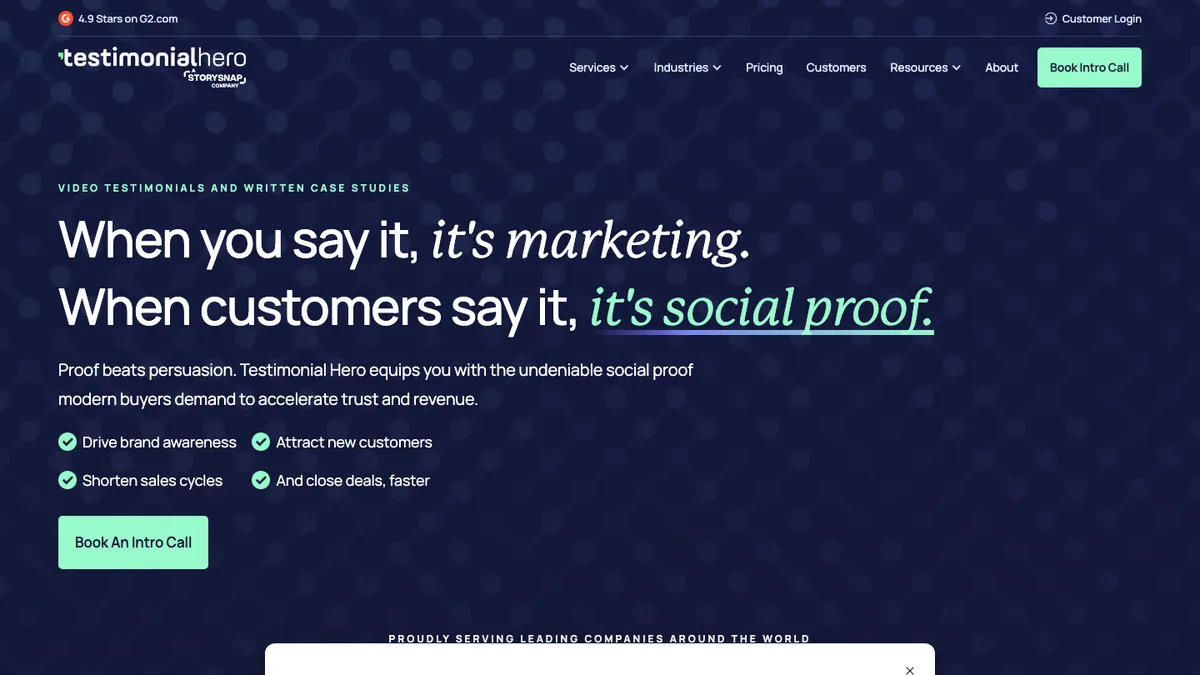
Testimonial Hero is the closest thing this category has to a default, and it ranks first because it leads on the criterion most buyers underestimate. The published numbers are 2,600 or more remote testimonials, 1,600 or more on-site, and over 100 captured at events, for clients including HubSpot, Intercom, Grammarly, Gong, Docusign, Amplitude, Qlik, Axonius and NinjaOne. That client list is technical B2B throughout, so the technical fluency criterion doesn't separate it from the field the way it separates most volume shops.
What you're buying is the operating system rather than the camera. Account strategists and creative project managers run the programme, creative producers run the interviews, and a global videographer network covers on-site work wherever your customer happens to be.
It's also one of only two companies here that publishes figures. Average costs are listed by package: video-only remote from $3,800 to $6,200, video-only on-site from $9,200 to $11,800, and bundles pairing video with a written case study from $6,000 remote or $11,600 on-site. In a category where almost everyone quotes privately, publishing the remote versus on-site gap is genuinely useful.
Who it's less suited for: Better suited to programmes measured in dozens than to one highly distinctive creative film. If you want a customer story with an unusual narrative treatment, a boutique studio built around one-off creative will take it further.
2. Apollo Studio
Best for: Customer stories where the product itself is hard to explain.
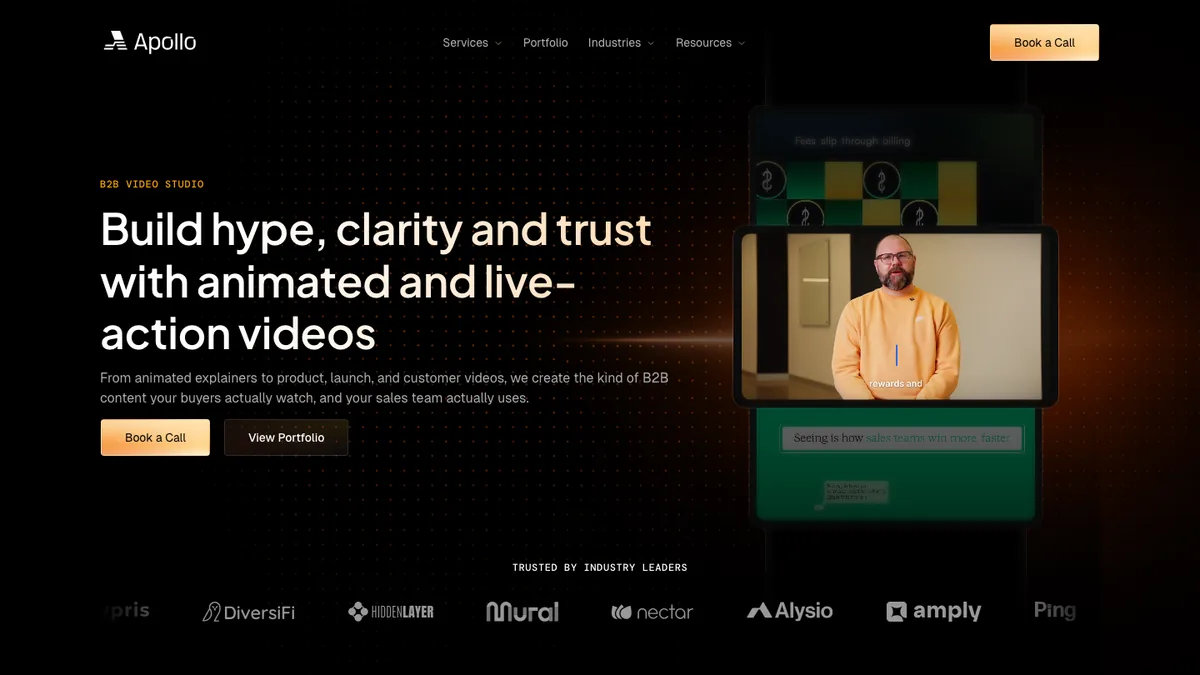
Apollo Studio works exclusively with B2B tech, covering SaaS, AI, fintech and cybersecurity, and it ranks second on an axis built around technical fluency because that narrowness is the whole proposition.
The portfolio is the evidence. Apollo Studio produced the customer story for Awardco, and its wider work covers Mural, Anvilogic in cybersecurity detection, Cypris AI for R&D teams, Mindsmith and Ping. Those are exactly the categories where a testimonial interview fails without category knowledge, where a customer says "it cut our triage time" and the producer either knows to ask what triage means for their team, or doesn't.
Motion design is produced in-house, which matters more for testimonials than it sounds. Customer stories about software need interface sequences cut into the interview, and building those without a subcontractor keeps the edit coherent. Turnaround is fast for the category: post in roughly a week, full productions in about three. Co-founder Cade Biegel runs strategy calls directly, and pricing starts at $10,000.
Who it's less suited for: Better suited to companies whose product needs explaining than to teams running high-volume proof programmes. If you need twenty customer stories filmed across four countries this quarter, a managed programme with a global videographer network is built for that and will serve you better. Buyers wanting one supplier across every category of video, including corporate and consumer work, will also want a broader production network.
3. CaseLeap
Best for: Companies treating customer proof as a continuous programme rather than a project.
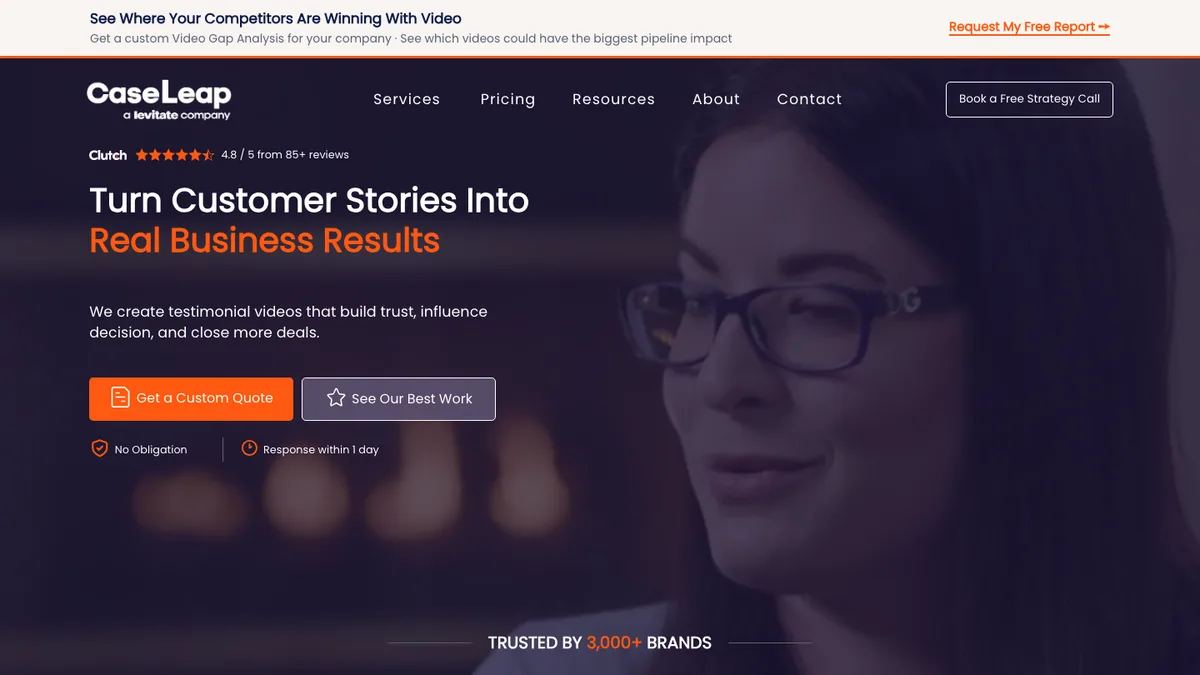
CaseLeap reports more than 3,000 customer stories produced, 75 industry awards, and an average client rating of 4.8 out of 5 across 85 or more Clutch reviews, which is the strongest verifiable review record on this list. Clients include Canon, Novartis, FireEye, Cornerstone, TAB Bank, Yodlee and the American Heart Association.
The service range is unusually complete: on-site testimonials, remote interviews, event capture, animated case studies, and written case studies from the same interview. That last point is the underrated one. A single customer conversation can yield a video, a written case study and a set of pull quotes, so planning for it gives you three assets for one ask of the customer, which is the scarce resource in this entire category.
CaseLeap also runs a video gap report, typically returned within a business day, identifying where proof is missing across the funnel. It's a sales device, but a useful one if you've never audited your proof coverage.
Who it's less suited for: Better suited to breadth across many industries than to depth in one. If you want a partner who already knows your technical category in detail, a vertical specialist will reach a working interview faster.
4. Vidico
Best for: Teams that need one customer shoot to produce many assets.
Vidico is among the most recognised names in B2B tech video, and its case study service is built around repurposing. A single customer shoot is planned to yield a hero film, vertical social cutdowns, paid ad variations and still assets, rather than one long video posted once.
For a team running paid social, that structure is the argument. The cost of a customer story is dominated by getting the customer to participate at all, so the economics improve sharply when one session produces eight usable assets instead of one. Subscriptions start around $5,000 per month and cover multiple formats under a single fee, which suits companies producing proof content continuously.
The portfolio skews toward high-growth software and the work is consistently polished.
Who it's less suited for: Better suited to teams producing continuously across formats than to those commissioning one definitive customer film. If you need a single story a year, a project studio will give that story more concentrated attention.
5. Venture Videos
Best for: SaaS teams that want the price before the call.
Venture Videos is a UK studio working exclusively with SaaS and tech, and it has helped more than 200 SaaS companies with launches, explainers and customer stories. Clients include Amazon, Google, Box and Bill.com.
It publishes customer story pricing in tiers, which almost nobody in this category does: the Customer Story from $15,000, the Strategic Customer Story from $30,000, and the Customer Proof Programme from $50,000. The tiering tells you what each buys, whether that's a single story, a story built around a strategic account, or a full programme. Publishing them removes the two-call discovery process that slows most video buying.
Delivery runs in as little as four weeks on a structured schedule: customer selection and planning in week one, filming in week two, editing in week three, delivery in week four. In a category where scheduling slippage is the norm, a published week-by-week plan is a meaningful commitment.
Who it's less suited for: Better suited to buyers who value price certainty and a SaaS-only partner than to teams working to a smaller per-story budget. If your programme depends on many lower-cost stories, remote-first specialists start considerably lower.
6. The Customer Story
Best for: Reference customers who are willing but almost impossible to schedule.
The Customer Story is a San Antonio studio built around a specific insight: testimonial programmes stall because the ask is too big. Its remote sessions run 30 to 45 minutes using the customer's existing devices, and on-location shoots are structured to take about two hours of the customer's day.
That framing is worth taking seriously. If your best reference customer is a VP who will give you forty-five minutes but not half a day, the company that can work inside forty-five minutes is the one that gets you the video at all. A good remote testimonial you actually captured beats an exceptional on-site one that never got scheduled.
Clients include Dell, Rackspace Technology, Bitdefender, Pure Storage, Epicor and ThousandEyes, which is a credible enterprise tech list. Packages are quoted flat rather than hourly, and most projects deliver within three to four weeks of the shoot.
Who it's less suited for: Better suited to enterprise and mixed-industry accounts than to deeply technical niche categories. If your customer is an engineer describing infrastructure, a studio working daily in that category will get more out of the interview.
7. Content Beta
Best for: SaaS teams producing testimonials alongside everything else.
Content Beta runs creative-as-a-service for B2B SaaS, covering video, motion and design on subscription from around $3,000 per month. Testimonials are one workstream among several rather than the whole offering, which is the right shape for teams whose proof content competes for budget with demos, launch videos and ad creative.
The model suits a specific situation: you need four customer stories this year, but you also need eleven other videos, and running separate procurement for each category is its own cost. A subscription that absorbs all of it removes that overhead, and per-asset costs fall once throughput is steady.
The team also publishes extensively on B2B testimonial video, which is reasonable evidence of how seriously it takes the category.
Who it's less suited for: Better suited to steady multi-format throughput than to a single ambitious customer film. If testimonials are the only thing you need, a dedicated specialist will go further on interview craft.
8. Umault
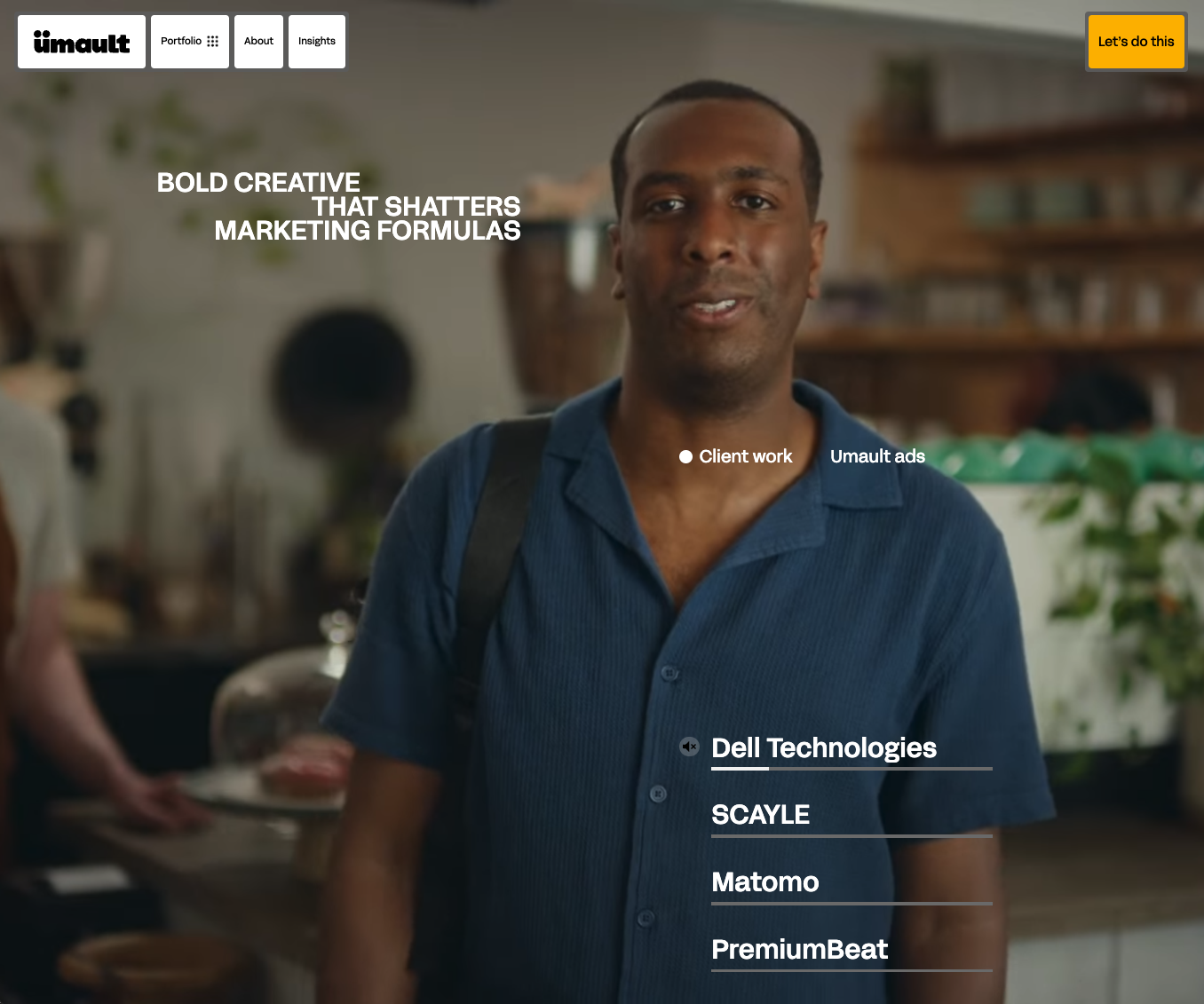
Best for: B2B brands whose customer stories need to not look like customer stories.
Umault is a boutique B2B video agency near Chicago, working with Dell Technologies, SCAYLE, Matomo, PremiumBeat and Mosaik. Its stated position is a reaction against corporate video convention, and the work backs it, sitting closer to advertising than to the interview-plus-b-roll format that dominates this category.
That's worth paying for in one specific case. If your competitors all publish the same talking-head-against-a-window testimonial, the format itself has stopped signalling anything, and a customer story shot with genuine cinematic intent is the one a buyer remembers. Umault's argument is that B2B video fails from being boring rather than from being unclear, which is true more often than the industry admits.
Who it's less suited for: Better suited to a small number of high-craft films than to a volume proof programme. If you need consistent output across many customers each quarter, a managed programme is structured for that in a way a boutique creative studio is not.
9. Demo Duck
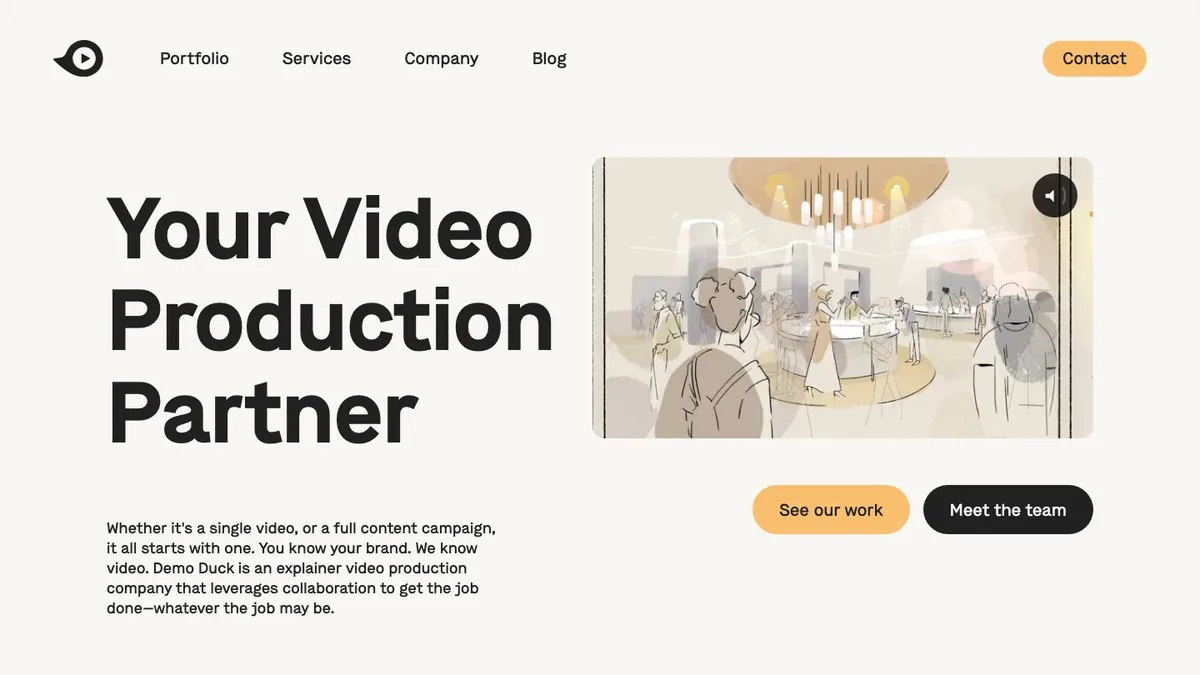
Best for: One flagship customer story with real production value.
Demo Duck is a Chicago studio with work for Netflix, Google and Geico, and genuine range across animation and live-action. For a customer story that needs to carry a homepage or open a keynote, that production ceiling is the reason to choose it.
The animation range matters more for testimonials than it first appears. Customer stories about software frequently need to visualise something the camera can't show, such as a workflow, a data flow, or a before-and-after. A studio that can build that properly, rather than cutting to a screen recording, ends up with a far more watchable film.
Pricing reports vary, with some sources placing projects at $8,000 to $20,000 and others reporting custom work starting nearer $25,000 with six to ten week timelines. Treat those as indicative and scope directly, since the spread most likely reflects the distance between a simple edit and a full production.
Who it's less suited for: Better suited to teams planning a quarter ahead than to those who need proof content quickly. If your timeline is weeks rather than months, remote-first specialists move faster.
10. Represent Studio
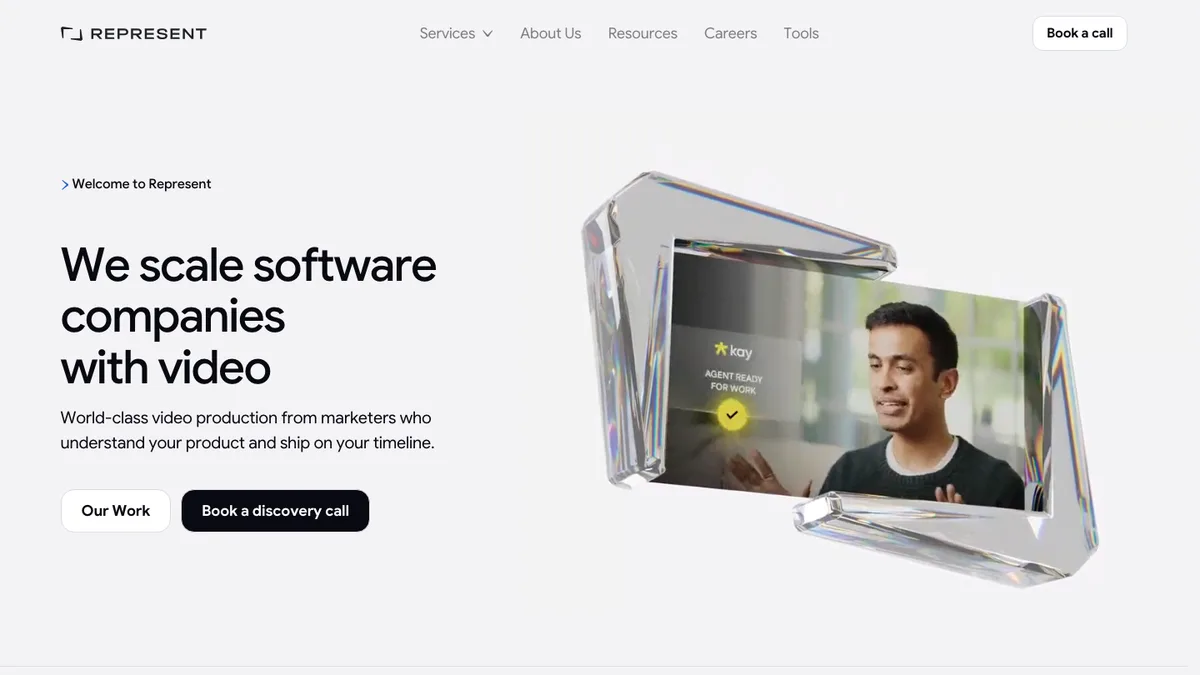
Best for: Venture-backed AI and developer tool companies.
Represent Studio works with software companies, and its client list is unusually current for this category: Dataiku, Otter, Lindy AI, E2B, Factory AI and FirstMark. Customer testimonials are a named service line alongside launch videos, tutorials and long-form YouTube.
The fit here is narrow and real. AI and developer tool companies have a specific testimonial problem, in that the customer is often an engineer who talks in specifics a general producer will flatten into nothing, and the product's value is frequently invisible on screen. A studio working continuously with that buyer arrives understanding it. The stated figures, 300,000 or more activated users and more than $1 billion raised by customers, describe the client base rather than the work, but they tell you accurately who this studio serves.
Who it's less suited for: Better suited to venture-backed software teams moving quickly than to enterprise buyers working through formal procurement. If you need a partner experienced with lengthy vendor onboarding and multi-stage legal review, a larger established agency will fit the process better.
Honorable Mentions
- Superside: Subscription creative at enterprise scale, worth considering when testimonials are one line in a much larger creative budget.
- Shootsta: Hybrid model combining client-captured footage with professional editing, which lowers per-story cost on high-volume programmes.
- Moonb: Embedded subscription creative team, useful when customer stories need to match a wider content system.
- MHF Creative: Case-study-focused B2B production with a dedicated customer story service line.
- Chasing Creative: Smaller studio with a specific case study video practice.
Which Testimonial Video Company Is Best For You?
Technically complex product. Apollo Studio or Represent Studio. The constraint is whether the interviewer understands what your customer is saying, which is a specialisation question rather than a production one.
You need twelve testimonials this year. Testimonial Hero or CaseLeap. Volume programmes need process, recruitment support and a videographer network, not a boutique.
You have one perfect reference customer and one shot at it. Umault or Demo Duck. Spend on craft, because you won't get a second session.
Your customers are senior and impossible to schedule. The Customer Story. The short remote format is designed for precisely this failure mode.
You're already producing video continuously. Content Beta or Vidico. Fold testimonials into the existing arrangement rather than opening a new supplier relationship.
You need to know the price today. Testimonial Hero or Venture Videos, the only two here publishing figures. Testimonial Hero from $3,800 for a remote story, Venture Videos from $15,000.
You're running paid social with proof creative. Vidico. The repurposing model is built for exactly that.
Testimonial Agencies vs Testimonial Software: Which Do You Actually Need?
Search for testimonial video and half the results are software. Vocal Video, StoryTap and similar platforms send your customer a link, record them through a browser, and assemble the result automatically. They're genuinely good products, and they solve a different problem from every company on this list.
Use a platform when the constraint is volume and cost. If you want forty short clips across your customer base at a price per story no agency can approach, self-serve software is the correct answer. It's also right for continuous collection, whether after onboarding, after renewal or following a support win, where the value is in having many recent voices rather than one polished film.
Use an agency when the constraint is quality or difficulty. A platform cannot interview. It can't hear a vague answer and push for the specific one, can't decide in the moment that the interesting story is the one the customer mentioned in passing, and can't direct a nervous VP into sounding natural. For a flagship customer whose story needs to carry your homepage, or a technical product where the explanation has to live inside the testimonial, that editorial judgement is the whole product.
Most mature programmes run both. Software for breadth, an agency for the handful of stories that matter most. The failure mode is choosing a platform for a flagship customer and ending up with a browser-recorded clip of the best reference you'll ever get, or commissioning an agency for forty routine clips and paying for craft nobody will notice at that volume.
The practical test: if you can name the specific customer and the specific deal their story needs to unblock, that's an agency story. If you're describing a category of customers rather than a person, that's a platform job.
How Much Does a B2B Testimonial Video Cost in 2026?
Testimonial pricing is less transparent than most video categories, because cost depends heavily on where your customer is and how many you're filming. Only two companies on this list publish figures at all. The bands below use those published numbers where they exist, and reported ranges where they don't.
- Under $1,000 per story: Self-serve platforms. Browser-recorded, automatically assembled, no interviewer.
- $3,800 to $6,200 per story: Remote professional testimonials with a real producer and editor. These are Testimonial Hero's published average costs for video-only packages, and the clearest public benchmark for remote capture.
- $6,000 to $8,600 per story: Remote testimonial bundled with a written case study, per Testimonial Hero's published video-plus-written tiers.
- $9,200 to $11,800 per story: On-site testimonials with a crew at your customer's location, again from Testimonial Hero's published figures. Bundled with written case studies, its on-site tiers run $11,600 to $13,348.
- From $10,000: Apollo Studio's published starting point for project work.
- $15,000 to $50,000: Venture Videos' published tiers: $15,000 for a Customer Story, $30,000 for a Strategic Customer Story, $50,000 for a full Customer Proof Programme.
- $3,000 to $5,000 per month: Subscription creative covering testimonials alongside other formats. Content Beta publishes from around $3,000, Vidico from around $5,000.
- $25,000 and above: Flagship customer films with full crew, travel and cinematic treatment.
The most useful number here is the gap between two of them. Testimonial Hero's own published figures put the same basic package at $3,800 remote and $9,200 on-site, a difference of roughly $5,400, or about two and a half times, for the identical deliverable filmed in person. That single comparison should drive your programme design more than any other figure on this page.
Factors That Influence Testimonial Video Pricing
Remote versus on-site. The single largest swing factor, and the one with public evidence behind it at roughly 2.5x on identical packages. On-site means crew, travel and equipment at your customer's location, and a multi-city programme multiplies that. Remote capture removes nearly all of it.
Customer recruitment. Whether the company helps identify, approach and schedule participants, or you arrive with a confirmed list. This is real work, and those who do it price for it. Usually worth paying, because it's the step where in-house programmes die.
Number of stories. Per-story cost drops substantially across a programme. Interview frameworks, brand treatment and edit templates carry forward, so story six costs meaningfully less than story one.
Deliverables per shoot. A hero film, cutdowns, vertical crops and quote cards from one session cost more than a single edit, but far less than commissioning them separately later.
Travel and location. A customer in your city and a customer three flights away are not the same line item. Programmes that cluster shoots geographically save real money.
Legal and approval cycles. Rarely priced explicitly, frequently the cause of overruns. Enterprise customers often need legal sign-off on the final cut, and experienced teams build that into the schedule instead of discovering it.
Final Thoughts
The instinct when hiring a testimonial company is to judge the showreel. It's a weak filter, because every reel here looks good. That's what a reel is for.
Judge the interview instead. Watch a full customer story from each company you're considering and ask one question: did the customer say anything specific? Not "it's been transformative" or "the team is great", but an actual number, an actual before-and-after, an actual moment where something changed. That specificity doesn't come from the camera. It comes from a producer who heard a vague answer and asked again.
The second thing to check is who owns the hard part. Ask directly how the company handles customer recruitment and scheduling, and listen for whether the answer is a process or a shrug. Teams that have run this before have a real answer, because they've watched enough programmes stall at exactly that step.
And be honest about which problem you have. If your product needs explaining, buy technical fluency. If you need volume, buy process. Very few companies are genuinely best at both, and the ones claiming to be are usually telling you about the showreel.
Related Articles
Frequently Asked Questions
A B2B testimonial video is a short film in which an existing customer describes their experience of a product or service, usually covering the problem they had, why they chose the vendor, and what changed afterwards. It typically runs 90 seconds to three minutes and is used on websites, in sales outreach and in paid campaigns. It differs from a case study video mainly in emphasis: testimonials lead with the customer's voice, while case studies lead with the situation and the results.
Most professionally produced B2B testimonial videos cost between $3,800 and $13,000 per story in 2026, based on the only published figures in the category. Testimonial Hero lists remote video testimonials at $3,800 to $6,200 and on-site at $9,200 to $11,800, rising to $13,348 when bundled with a written case study. Venture Videos publishes tiers from $15,000 to $50,000, and Apollo Studio starts at $10,000. Subscription partners such as Content Beta start around $3,000 per month across multiple formats, and flagship customer films exceed $25,000. Self-serve software platforms cost far less but don't include an interviewer.
Ask soon after a clear win, make the commitment explicit and small, and offer remote capture as the default. Participation rates rise sharply when the ask is a 30 to 45 minute video call rather than a half-day on-site shoot. It also helps to confirm the customer approves the final cut, to handle legal review early rather than at delivery, and to offer something in return, usually co-marketing exposure rather than payment, which can compromise credibility.
Two minutes works for a website hero testimonial. Cut a 30-second version for paid social and a 60-second version for sales outreach. Longer edits of three to five minutes suit late-stage buyers and sales enablement, where the viewer is already motivated. Always cut multiple lengths from the same interview, because the footage cost is already sunk and the shorter versions usually get more use.
On-site produces better craft and is the right choice for flagship stories. Remote produces more testimonials, because the ask is far smaller and more customers say yes. Most effective programmes use remote as the default and reserve on-site for the handful of customers whose stories carry the most weight. On published figures, the same package costs roughly two and a half times more on-site.
A testimonial leads with the customer speaking about their experience and is built around their voice. A case study video is structured around the problem, the solution and measurable results, often with narration, data and product footage alongside the interview. Testimonials build trust, case studies build the argument. Many companies produce both from a single interview.
Use software when you want many short clips cheaply and continuously, and an agency when quality or interview difficulty is the constraint. Platforms can't interview, so they can't push past a vague answer or direct a nervous participant. For flagship customers or technically complex products, that editorial judgement is what you're paying an agency for. Mature programmes typically run both.
Start with three, covering your main buyer personas or use cases, rather than three versions of the same story. Most B2B teams get more value from four differentiated stories than from a dozen similar ones. Once you know which stories sales actually sends, expand along that pattern.
Four to six weeks from brief to delivery is typical, with most companies delivering three to four weeks after the shoot date. The variable that dominates the timeline is customer scheduling rather than production, since it routinely takes longer to get the customer into the chair than to produce the finished video. Legal approval at the customer's end can add another two weeks for enterprise accounts.
Track completion rate first, then conversion on the pages where the video sits, comparing against the same page without it. Downstream, look at whether deals that received the video close at a higher rate or move faster. The most reliable informal signal is whether your sales team sends it without being asked, because reps drop assets that don't help.
Explore Our Blog Posts
Discover insightful articles on cybersecurity and more.

Best Video Agencies for Developer Tools Companies (2026)
How to Choose a B2B Video Production Agency (2026 Guide)