
How to Choose a B2B Video Production Agency in 2026: A Comparison Guide


Key Takeaways:
- Pick the vendor type before the vendor. Specialist studio, generalist production company, creative subscription, presenter production line, or freelancer: each fits a different volume and a different job.
- Match specialisation to your buyer, not your industry. An agency that has explained software to a technical buyer will do it again; one that has shot fifty corporate videos will make a corporate video.
- Verify the work, not the reel. Watch a full video for a product you have never heard of, check the named clients on the agency's own site, and ask who on the team made it.
- Compare engagement models on a year of output, not one video. A $10,000 project and a $3,000-a-month subscription are for different jobs; the cheaper one is whichever matches your cadence.
- Insist on a written scope, a named team and a date. The three things that go wrong are scope creep, a junior team you did not meet, and a video that arrives after the moment it was for.
- Published pricing is a signal, not a rule. Wyzowl, Videodeck, Content Beta, Broadcast2World and Motion The Agency publish rate cards; Apollo Studio, Demo Duck and Venture Videos publish starting points; Sandwich Video and Vidico quote.
- For B2B tech companies with a product that needs explaining, a specialist studio is usually the right first call. Apollo Studio is the closest fit for that brief on this list; the rest of the guide says when someone else is.
Choosing a B2B video production agency comes down to three decisions, in this order: which kind of vendor matches how many videos you will make this year, which agency inside that kind understands your buyer, and whether the work they show you was made by the people who will make yours. Most bad hires skip the first decision and compare a specialist studio against a creative subscription on price, which is like comparing a chef against a meal kit.
This guide is built for B2B software and tech companies, where the product usually has to be explained before it can be sold and the video has to work on a technical buyer. It covers the five kinds of vendor and when each fits, the ten things to look for, a scoring template you can put ten agencies through in an afternoon, how the pricing models compare, the questions to ask on the first call, and ten agencies compared side by side using their own published figures.
Start With the Brief, Not the Agency
Four questions decide almost everything, and most teams cannot answer them when they start taking calls.
What job does the video have to do? Earn a sales call from a buyer who does not understand the product (explainer, product demo). Make a release feel like an event (launch film). Prove the product works for someone like the buyer (customer story). Stop the scroll in paid social (video ad). Each is a different craft, and most agencies are better at one than the others.
How many videos will you make this year? One or two flagship pieces is a project brief. Four or more a month is a subscription or retainer brief. Somewhere in between is a bundle. The answer determines which vendor type you should be talking to at all.
Who is on camera? Your founder or your customers, which needs a studio that can direct people who are not actors. A hired presenter, which needs a production line with a roster. Nobody, which means animation and a studio whose motion design is in-house.
When does it have to exist? A launch date next month rules out the studios that run eight to ten weeks. A quarter of lead time opens up the flagship animation studios. Know the date before the first call and ask every agency to commit to it in writing.
Write those four answers down. They are the brief, and the rest of this guide is how to score agencies against it.
The Five Kinds of B2B Video Vendor
The market has sorted itself into five models. Comparing across them on price alone is the most common mistake.
| Vendor type | What it is | Typical pricing | Typical turnaround | Best for | Watch for |
|---|---|---|---|---|---|
| Specialist studio | A small senior team that works only in B2B or tech, scopes each project, and does script through delivery in-house | From about $10,000 per project; bundles for several pieces | 3 to 6 weeks | One or a few videos that have to land with a technical buyer | Confirm the senior team is the delivery team |
| Generalist production company | A crew-for-hire that shoots corporate, events, real estate and B2B alike | $5,000 to $50,000+ per project | 4 to 10 weeks | Live-action shoots where you bring the script and the strategy | Portfolio breadth means less software fluency |
| Creative subscription | A monthly plan or credit pool covering video, design, motion and ads from one team | $3,000 to $15,000+ a month | Days per request | Teams shipping several pieces a month across formats | Per-piece depth is lower; flagship films are not the model |
| Presenter production line | A studio with in-house spokespeople, built sets and a fixed cycle | $2,000 to $5,000 per video on plans | About 10 working days | Feature updates, tutorials and educational video at cadence | The look is the studio's, not yours |
| Freelancer or marketplace | An individual editor, animator or director, or a platform that matches you to one | $500 to $5,000 per piece | Varies | Cutdowns, edits and one-off pieces with your own direction | You are the producer; there is no strategy layer |
In-house is the sixth option and worth stating plainly: a video lead plus a freelancer bench costs $90,000 to $150,000 a year in most US markets before equipment, and it makes sense once you are producing weekly. Below that, the vendor types above are cheaper and better.
For most B2B tech companies, the real choice is between the first, third and fourth rows, and it is decided by volume and by whether the next video is a flagship or a cadence.
What to Look For in a B2B Video Production Agency
Ten things, in rough order of how often their absence causes a bad outcome.
1. Specialisation in your buyer
Not your industry, your buyer. A software company selling to security engineers needs an agency that has made a security engineer understand a product before. Look for named clients in your category on the agency's own site, with the actual videos attached, and watch one. If you understood the product at the end, that is the test passed.
2. Story before production
The best B2B videos are decided in the script. Ask how the agency gets from your brief to a script: who writes it, how many discovery calls, whether positioning work is included or assumed. An agency that goes straight to "what style do you want" is selling production, not communication.
3. The team you meet is the team you get
The most common quiet failure in agency hires. A senior creative director runs the pitch, the work goes to a junior or an offshore partner, and the result is generic. Ask who will write, direct and animate your piece by name, and whether they made the samples you were shown.
4. In-house motion design
For software, the interface is the story, and interface sequences are where most demos lose coherence. In-house motion design means the animator and the writer sit together. Outsourced motion means the interface is rendered by someone who did not read the brief.
5. A published price or a clear scoping process
Rate cards (Wyzowl, Videodeck, Content Beta, Broadcast2World, Motion The Agency) tell you the number before the call. Starting points (Apollo Studio from $10,000, Demo Duck's "at least $16,000", Venture Videos from $40,000 on launches) tell you the floor. Custom quotes are fine if the scoping process is written and the quote itemises what a change costs. What to avoid is a price that only exists at the end of a discovery process you are paying for with your time.
6. A stated turnaround and a date in writing
Ask for the standard timeline and for the date your video will be delivered. A studio that answers with a number (ten working days, six working days for sixty seconds, about three weeks, four weeks committed) is one that has a process. A studio that answers "it depends" will be late.
7. Deliverables planned as a set
One master file is not a deliverable in 2026. A product video runs on the homepage, in outbound, in the deck, in paid at 15 seconds and on LinkedIn in a square crop. Ask whether cutdowns, aspect ratios and captions are in the quote or extras, and whether they are planned into the edit or cropped afterwards.
8. Revisions and change policy
Know how many rounds are included and what a late change costs, because in B2B the late change always comes: legal rewords a claim, product renames a feature, the founder wants a different opening. Wyzowl and Videodeck include unlimited revisions; most others include two or three rounds. Neither is wrong, but you should know which you are buying.
9. Rights and source files
You should own the finished video outright and receive the project files, so your internal team or a freelancer can recut it when the interface changes. Several agencies state this on their pricing pages; ask the ones that do not.
10. A limitation they will state
Every good agency knows who it is wrong for. Ask "who should not hire you?" A specialist studio will say "a team that needs forty clips a month". A subscription will say "a company that wants one flagship film". An agency that says it is right for everyone has not thought about it.
The Scorecard: How to Compare Agencies Side by Side
Put every shortlisted agency through the same sheet. Score each row from 1 to 5, multiply by the weight, and add it up. The weights below are for a B2B tech company with a product that needs explaining; move them if your brief is different.
| Criterion | Weight | Score 5 looks like | Score 1 looks like |
|---|---|---|---|
| Fit for your buyer | 25% | Named clients in your category with videos you can watch and understand | Broad corporate portfolio, nothing in software |
| Story and scripting process | 20% | Discovery, positioning and script are in the process and priced | "Send us your script" |
| Team continuity | 15% | Named senior team, made the samples, will make yours | Pitch team differs from delivery team |
| Interface and motion craft | 10% | Motion design in-house, interface sequences clear | Outsourced or template motion |
| Pricing clarity | 10% | Rate card or starting point, itemised changes | Number only after a long discovery |
| Turnaround commitment | 10% | Stated timeline and a date in writing | "It depends" |
| Deliverable set | 5% | Hero, cutdowns, ratios and captions planned in | One master file |
| Rights and revisions | 5% | Full ownership, source files, clear revision policy | Licensing terms, files withheld |
An agency scoring above 4.0 weighted is a safe hire for the brief. Two agencies within 0.3 of each other are a coin toss on paper, so decide on the one whose full video you liked more.
How to Compare the Pricing Models
The number on the quote matters less than the model behind it. Four models cover the market, and each is cheapest for a different year of output.
Project pricing. One scope, one price, nothing in the months you make nothing. Published starting points on this list run from about $2,700 (Wyzowl) through $10,000 (Apollo Studio) and $16,000 (Demo Duck's guidance) to $40,000 (Venture Videos, launch projects), with Sandwich Video reported in the six figures. Right for one to four videos a year where each has to land.
Bundles. Several scoped pieces planned together at a lower per-piece rate. Videodeck publishes $5,000 for one video falling to $3,000 each for ten; Apollo Studio states that per-video pricing is meaningfully better on a bundle than a one-off. Right for a launch that needs three pieces, or a year with a known slate.
Subscriptions and credits. A monthly fee for a defined capacity. Content Beta from $3,000 a month, Motion The Agency from $3,950, Vidico from about $5,000, Superside from $15,000 on an annual term, with Videodeck's plans from $10,000 a month for four presenter videos. Right for four or more pieces a month in a consistent format; wrong for a single flagship film, which subscriptions are not built to make.
Retainers. A monthly commitment to a studio's time rather than a fixed output, usually with rollover and a minimum term. Broadcast2World publishes from $3,200 a month; Apollo Studio offers retainers and scopes them per client. Right for a company that wants a senior team on call across a year of varied work.
Work it out on twelve months. A team making one hero explainer and a customer story is better off on two projects at $10,000 to $20,000 each than on a $5,000-a-month plan it uses twice. A team making a product update every fortnight is better off on a plan at $2,000 to $3,000 a video than on twenty-four scoped projects. The model, not the agency, is usually the cost decision.
Ten Questions to Ask on the First Call
1. Which three of your videos are closest to what we need, and who on your team made them? 2. Who will write our script, and how many conversations with us happen before it exists? 3. What is your standard timeline, and will you commit to our date in writing? 4. What is included in the price, and what does a change after script approval cost? 5. How many revision rounds are included, and at which stages? 6. Do we own the finished video and receive the project files? 7. Which cutdowns, aspect ratios and captioned versions are in the quote? 8. How do you handle the interface changing between approval and delivery? 9. Who should not hire you? 10. What would you need from us to make this the best piece you have made this year?
The last question is not flattery. The answer tells you whether the agency thinks about the work or the invoice.
Red Flags Worth Walking Away From
- A reel with no full videos behind it. Highlight reels hide pacing, structure and whether the product was ever explained.
- Clients named on the site with no work attached. Logos are cheap. A project page with the video is not.
- No one on the call who will touch your project. Sales-led agencies are fine at scale; for a single flagship piece you want to meet the director.
- A price that will not exist until after discovery. Discovery is valuable; using it to withhold a number is not.
- "We do everything." Corporate, wedding, real estate and B2B software on one portfolio page is a production company, not a B2B agency, and there is nothing wrong with that if you bring the strategy yourself.
- Template motion. If three videos on the reel share the same stock transitions and the same royalty-free track, yours will too.
- No stated limitation. See point ten above.
None of these is about quality. Each is about whether the agency's model matches the job you are hiring for.
Ten B2B Video Production Agencies Compared
The agencies below are ordered by how closely each matches the brief this guide is written for: a B2B tech company with a product that has to be explained to a technical buyer, making a few videos that have to land. Every figure is from the agency's own site. The order says nothing about quality, and the routing section after the table says when a lower entry is the better hire.
| Agency | Vendor type | Best for | Pricing | Turnaround | Better Suited For… Than… |
|---|---|---|---|---|---|
| Apollo Studio | Specialist studio | B2B tech product, explainer and launch video | From $10,000 | Full productions in about 3 weeks | A few videos that have to land with a technical buyer, than volume content |
| Vidico | Creative department on credits | Multi-format output with a long SaaS track record | $1,500 to $50,000 per project; plans from about $5,000 a month | 6 to 8 weeks first production | Continuous multi-channel creative, than one fast piece |
| Demo Duck | Project animation studio | Flagship animated explainers | Budget at least $16,000 (its own guidance) | 8 to 10 weeks | A hero piece planned a quarter ahead, than a monthly cadence |
| Wyzowl | Fixed-price animation | Price and date certainty | From £2,000 (about $2,700) | 4 to 6 weeks, fixed dates | Animated explainers at a known price, than bespoke live action |
| Sandwich Video | Premium live-action studio | Founder-led launch and brand films | Custom, reported six figures | Custom | Well-funded launches, than seed budgets |
| Content Beta | Creative subscription | Product creative every release | $2,000 per one-off video; $3,000 a month | 1 to 2 days on subscription; 10 days one-off | Steady volume across formats, than a flagship film |
| Videodeck | Presenter production line | Presenter-led product video at cadence | From $5,000 per video; plans from $2,000 per video | Under 10 working days | Weekly educational and feature video, than a distinct visual world |
| Broadcast2World | Fixed-fee animation with retainer | Animated explainers with a compliance gate | $2,000 to $9,500 by tier; retainer from $3,200 a month | 4 to 6 weeks | Regulated content with formal sign-off, than founder-led films |
| Venture Videos | Enterprise SaaS launch agency | Launches on a committed date | From $40,000 (launch projects) | 4 weeks, committed | Enterprise launches with a fixed date, than early-stage budgets |
| Motion The Agency | Fixed-price motion studio | UI animation in days | From $3,480 per project; $3,950 a month | 6 working days for 60 seconds | Animated interface videos fast, than live action |
1. Apollo Studio
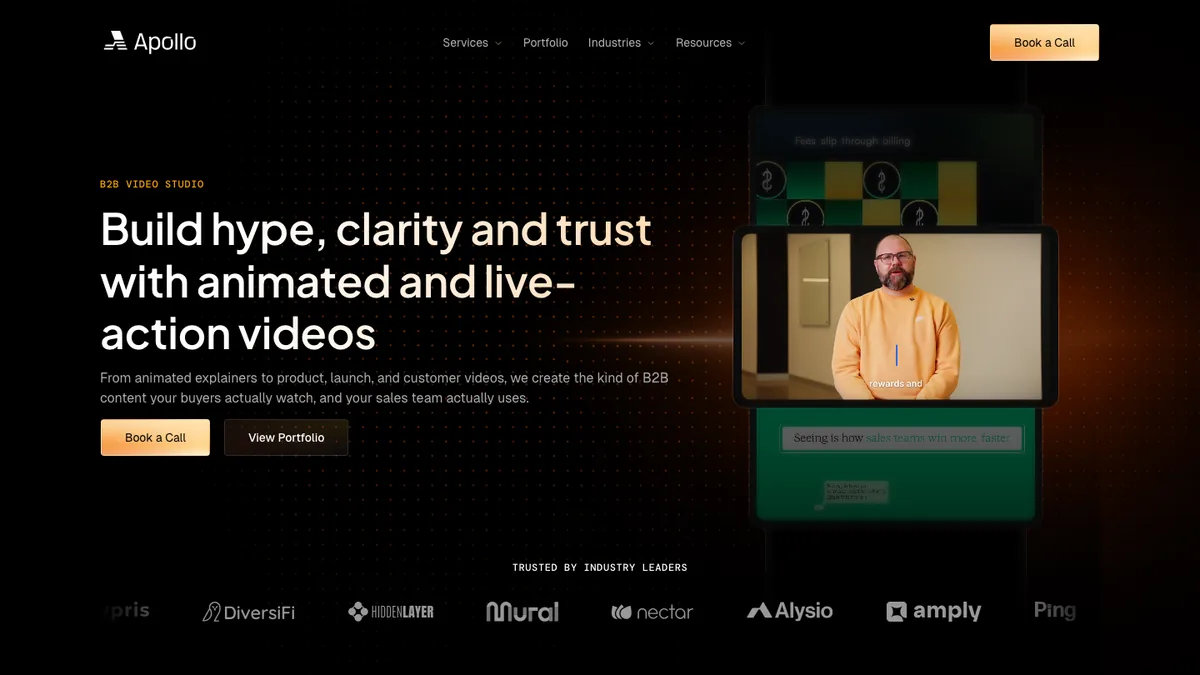
Vendor type: Specialist studio. Best for: B2B tech companies whose product has to be understood by a technical buyer.
Apollo Studio is the specialist-studio model as this guide describes it. It works only with B2B tech, scopes each project, and the senior team on the strategy call is the team that makes the piece; co-founder Cade Biegel runs those calls. Story comes before production as a stated process, motion design is in-house, and real founders, customers and employees are on camera as a principle. The work covers the formats this guide's buyer needs: product explainers for Mural and Redo, a product tour and launch films for Ping, a customer story for Awardco, and for Vanta a product promo followed by a monthly product-update series shot in the studio. Full productions take about three weeks; pricing starts at $10,000 per project, with bundles and retainers scoped per client.
Who it's less suited for: Better suited to a few videos that have to land than to a team that needs forty short clips a quarter, which is a subscription or production-line brief.
2. Vidico
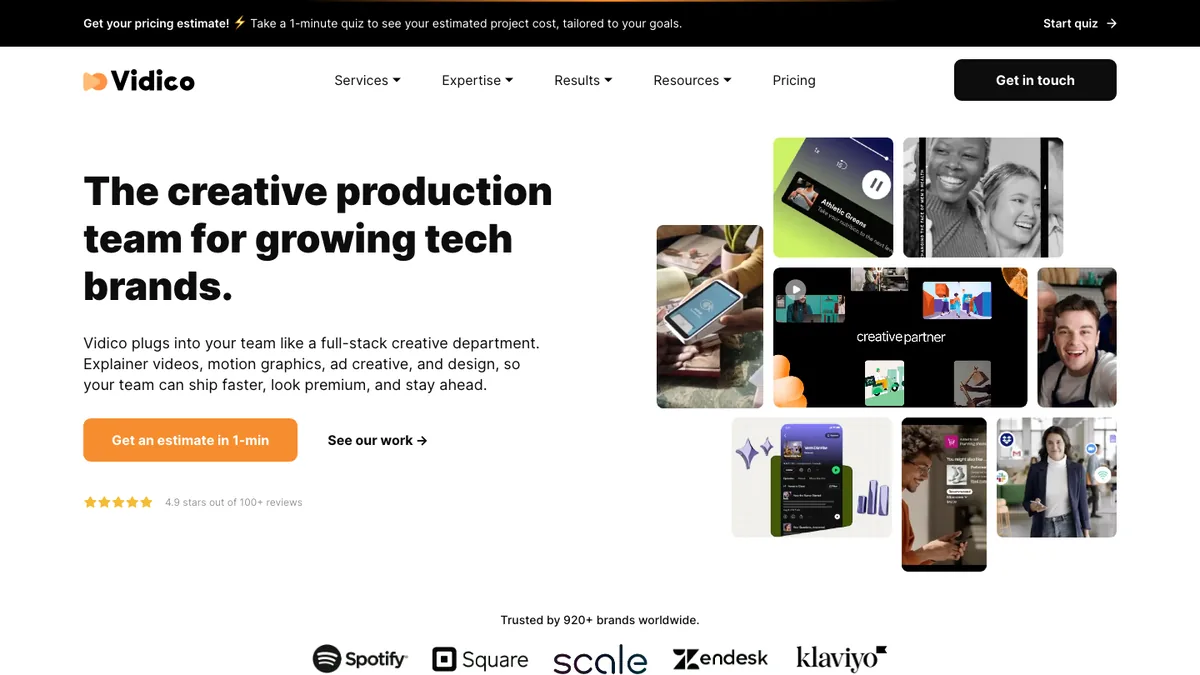
Vendor type: Creative department on credits. Best for: Marketing teams routing video, motion, ad creative and design through one vendor.
Vidico has the deepest SaaS client list in the category, with Spotify, Square, Zendesk, Klaviyo and TikTok on it, and reports more than 2,000 campaigns for 920-plus brands with a 4.9-star rating from over 100 reviews. It now sells itself as a full-stack creative department on flexible credits with rollover, producing animation and live action, and plans one production to yield more than 40 assets across channels. Per-project work is published at $1,500 to $50,000 on its industry pages and plans start at about $5,000 a month, set through a short quiz. First productions run six to eight weeks.
Who it's less suited for: Better suited to continuous multi-channel output than to a company that wants one specialist on one piece in four weeks.
3. Demo Duck
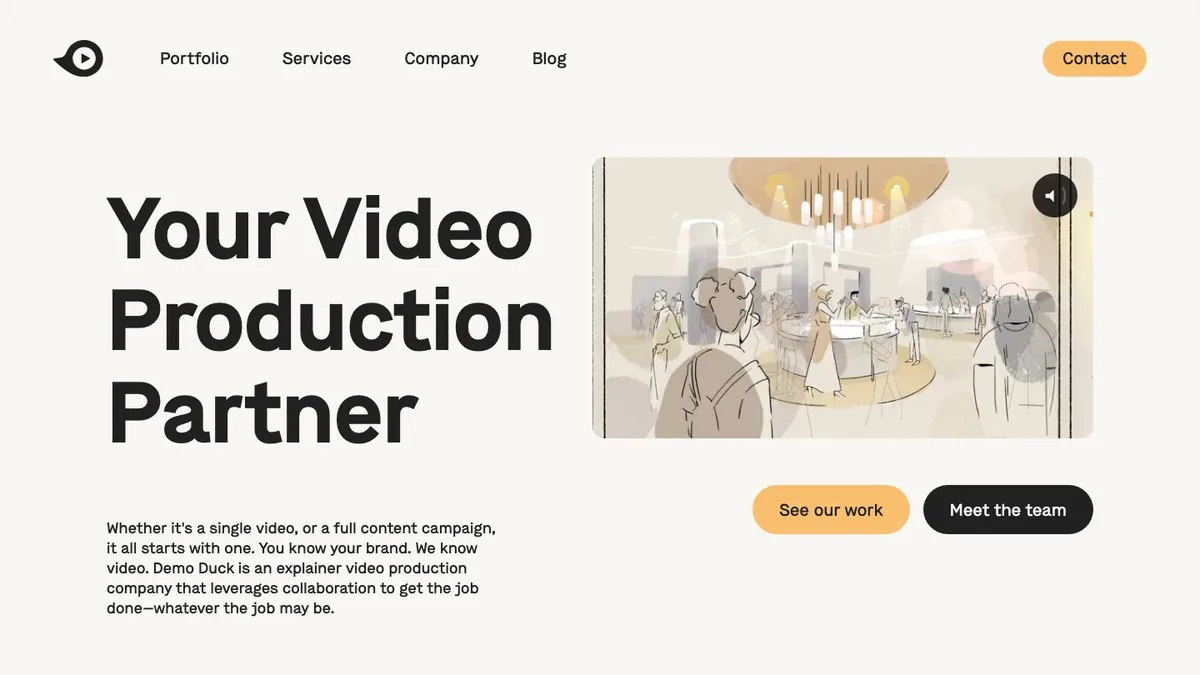
Vendor type: Project animation studio. Best for: A flagship animated explainer with deep creative development.
Demo Duck is a Chicago studio founded in 2011 with animated and live-action work for Netflix, Google, Dropbox, Lenovo, IBM Watson and Northwestern Mutual, and a process that runs discovery, script, storyboard, style frames and animation with the creative director involved throughout. Its own cost guide says to budget at least $16,000 for a quality explainer and its timelines run eight to ten weeks, which is the honest shape of a hero piece planned a quarter ahead.
Who it's less suited for: Better suited to one flagship piece with lead time than to monthly updates or a launch next month.
4. Wyzowl
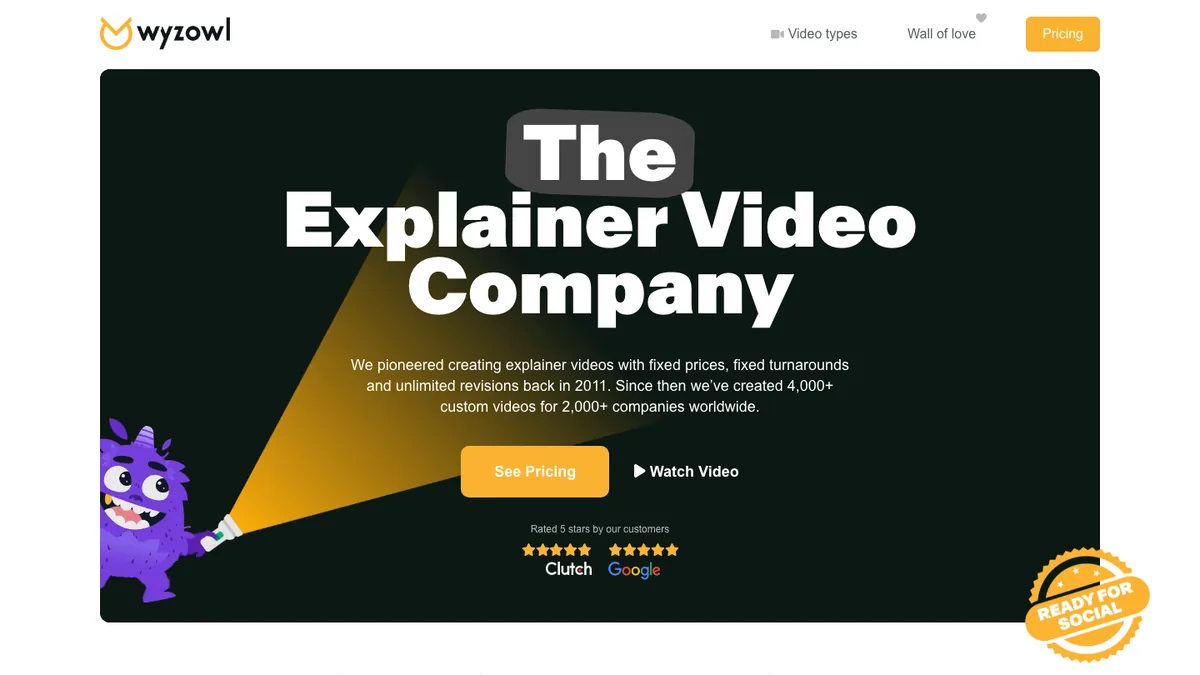
Vendor type: Fixed-price animation. Best for: Buyers who want the price and the date before the first call.
Wyzowl has produced more than 4,000 videos for 2,000-plus companies since 2011 and publishes its whole model: fixed price from £2,000 (about $2,700) all-inclusive, unlimited revisions at every stage, fixed delivery dates, and a project platform used by more than 1,000 agencies. Clients include Capital One, JotForm and Mavenlink, and it runs industry practices for fintech, cybersecurity, insurance and SaaS with a compliance stage for regulated work. Most projects complete in four to six weeks. The work is animation.
Who it's less suited for: Better suited to price and date certainty on animation than to live action, founders on camera or a small senior team on every call.
5. Sandwich Video
Vendor type: Premium live-action studio. Best for: The launch or brand film that becomes the news.
Sandwich Video, founded by Adam Lisagor in Los Angeles, defined the founder-on-camera tech launch film and still makes the best-known examples, with Perplexity, Gamma, Descript, Brex, Postman, Square, Robinhood, Capital One and Instacart on the current roster. It makes TV spots, explainers, testimonials, brand films and animation. Pricing is custom and reported in the six figures, and the studio is selective, so it belongs on a Series B budget with a flagship moment to spend it on.
Who it's less suited for: Better suited to a well-funded flagship than to product explainers at volume or any team that needs a published price.
6. Content Beta
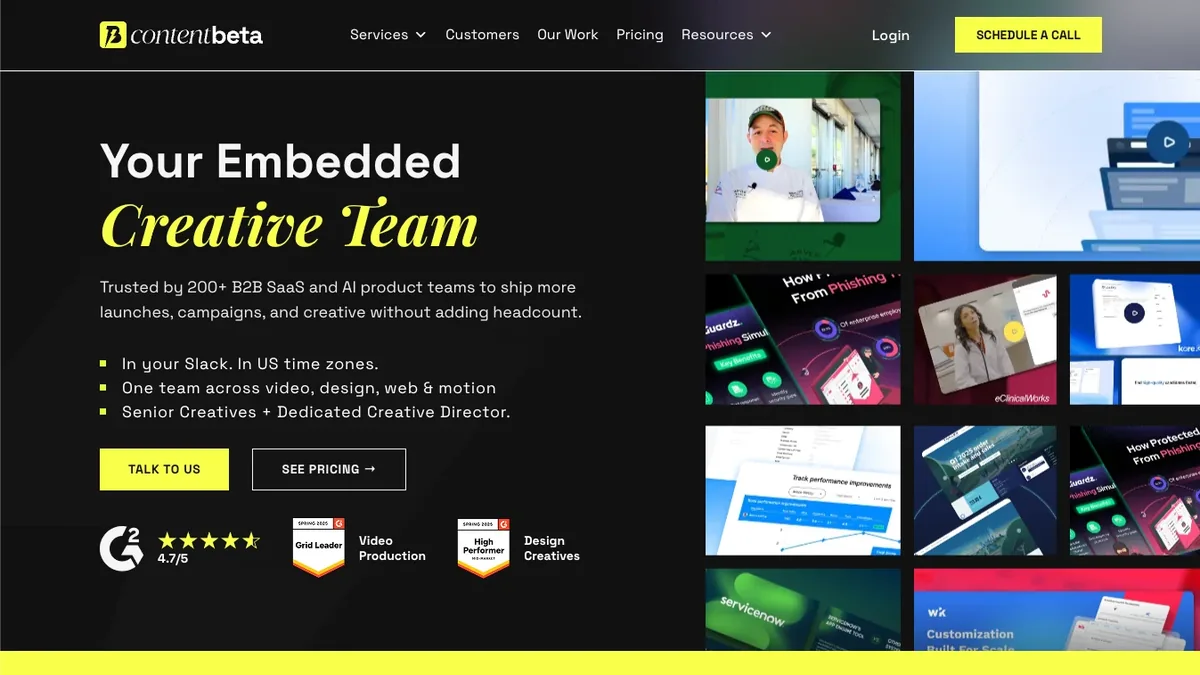
Vendor type: Creative subscription. Best for: Product-led SaaS teams shipping creative every release.
Content Beta sells a creative subscription at $3,000 a month covering video, design, motion and web from one pool of rollover credits, with a dedicated creative director, a Slack workflow and most requests turned in one to two days; a one-off product video is $2,000 with a ten-day turnaround. G2 rates it 4.7 from 86 reviews and clients include ServiceNow, Sendbird and Constructor. Its published typical month (a demo, two motion ads, two static ads, ten slides, a LinkedIn reel) is the shape of a product marketing team's release cycle.
Who it's less suited for: Better suited to steady volume across formats than to one flagship film or a customer story shot on location.
7. Videodeck
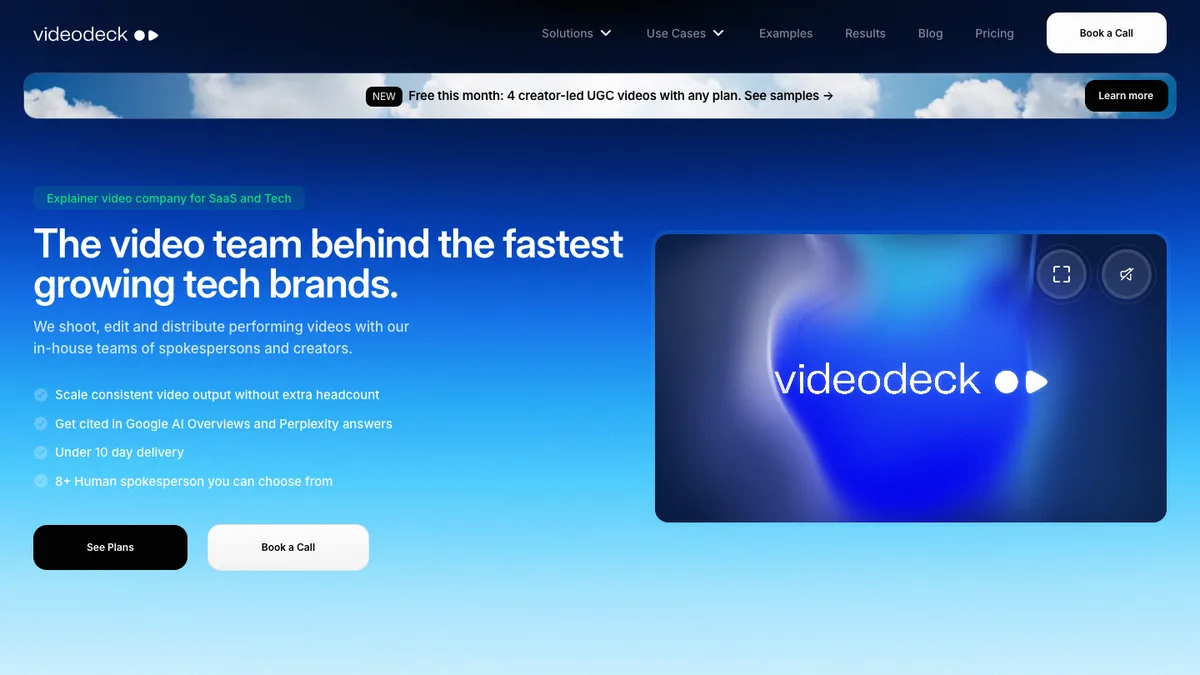
Vendor type: Presenter production line. Best for: SaaS teams that need presenter-led product video every week.
Videodeck built a production line for presenter-led B2B video: an in-house spokesperson on a custom set, cut with product screens and animation, delivered in ten working days with unlimited revisions and full ownership. It owns studios in Oradea and Austin, reports more than 1,000 videos for over 100 software companies including Ahrefs, CloudZero, Nightfall AI and Cyberhaven, and publishes its full rate card: $5,000 for one video, $3,000 each for ten, and monthly plans from $2,500 per video for four a month to $2,000 for twelve.
Who it's less suited for: Better suited to volume and speed in a consistent format than to a flagship piece that has to look unlike anything else.
8. Broadcast2World
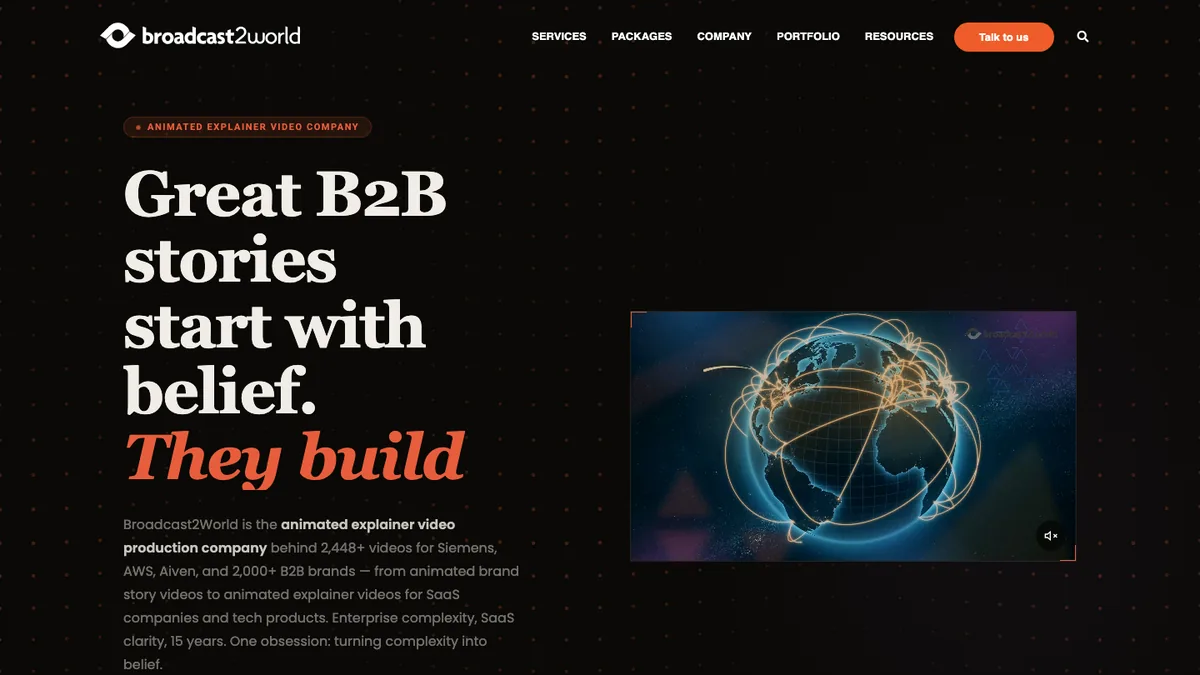
Vendor type: Fixed-fee animation with a retainer. Best for: Regulated content that needs legal sign-off before animation.
Broadcast2World has produced animated video since 2010 and publishes tiered fixed fees on its industry pages, from $2,000 for a 30-second social explainer to $9,500 for 3D or data visualisation, with a monthly retainer from $3,200. Clients include Citibank, Interactive Brokers, OnDeck, Microsoft and LendingUSA, and it shows a Clutch rating of 4.9. Script and storyboard sign-off with the client's legal and compliance team happens before animation begins. Delivery is four to six weeks.
Who it's less suited for: Better suited to animated explainers and training with a formal approval chain than to founder-led films or anything shot on location.
9. Venture Videos
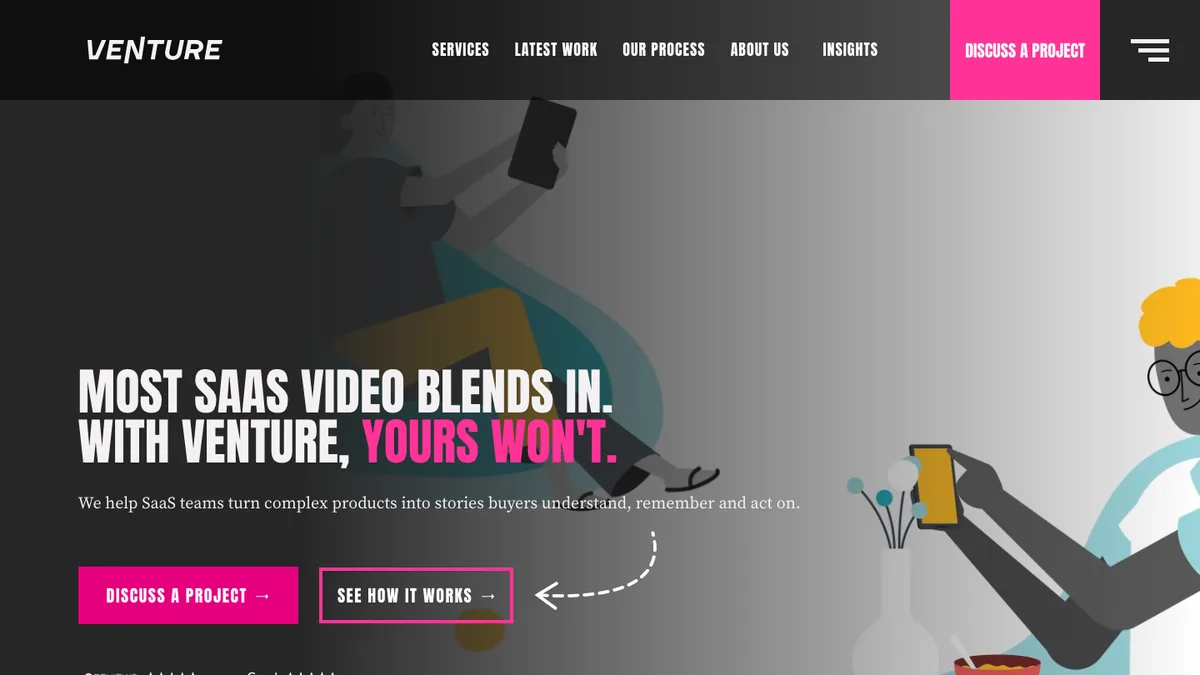
Vendor type: Enterprise SaaS launch agency. Best for: Launches with a fixed date, many stakeholders and a real budget.
Venture Videos is a SaaS video agency with offices in New York, London and Nottingham whose launch page commits to four-week delivery with a Launch Date Commitment and publishes a starting price of $40,000 for launch projects. Launch work includes the Box AI announcement film and a platform launch for Albert within the Henkel group, with Amazon, Bill.com, TSMC, Google and Workday among the logos on the page, and the offer is delivered as a launch suite: hero film plus landing page, paid, sales and social variants.
Who it's less suited for: Better suited to enterprise launches with a five-figure budget and a hard date than to an early-stage company or a small feature release.
10. Motion The Agency
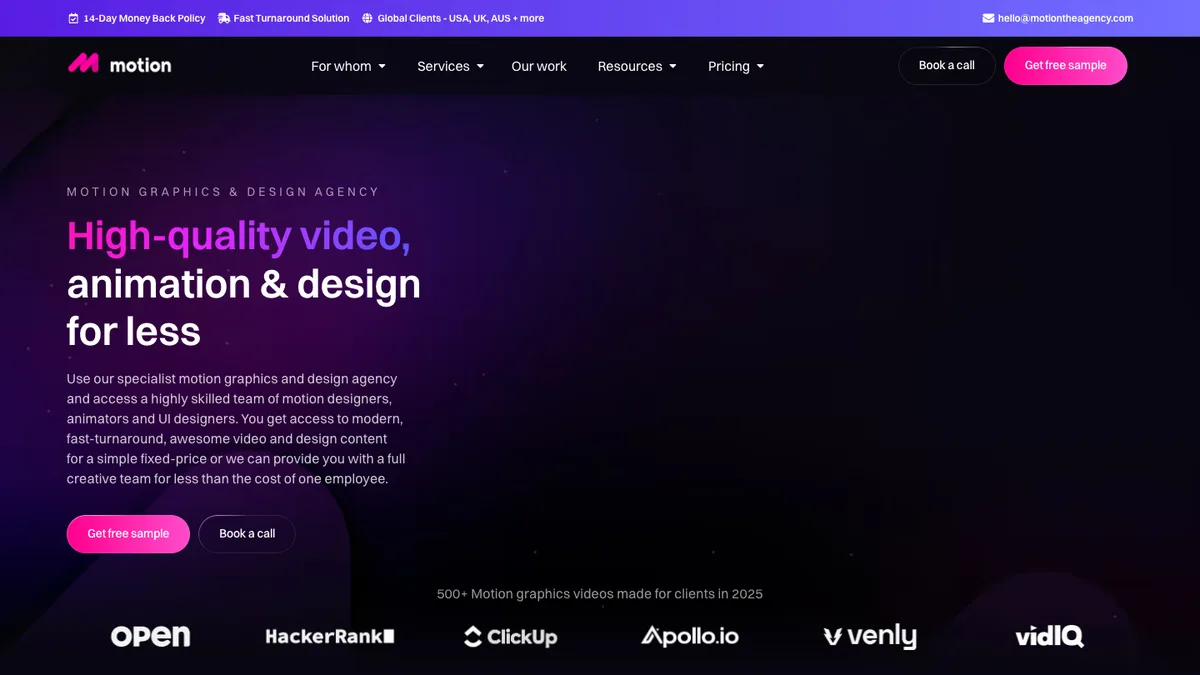
Vendor type: Fixed-price motion studio. Best for: Animated interface videos in about a week.
Motion The Agency is a London-registered motion graphics and design studio with clients including HackerRank, ClickUp, Attio, Bonsai and VidIQ, reporting more than 500 motion graphics videos in 2025. UI animation is a stated specialism, and it publishes all three engagement models: fixed-price projects from $3,480 with six working days for a 60-second video, a subscription from $3,950 a month, and prepaid credits from $18,000, with full commercial rights and source files on everything.
Who it's less suited for: Better suited to animated feature and interface videos than to anything with a person on camera.
Which Kind of Agency Is Right for You?
You have one or a few product videos that have to land with a technical buyer. A specialist studio. Apollo Studio is the closest fit for that brief; Demo Duck if the piece is a flagship animated explainer with a quarter of lead time.
You ship creative every release across video, ads and decks. A creative subscription. Content Beta at $3,000 a month, Vidico at about $5,000 for the deepest SaaS track record, Superside from $15,000 for enterprise consolidation.
You need a presenter-led product or tutorial video every week. A presenter production line. Videodeck.
You want the price and the date before the first call. Wyzowl, Broadcast2World, Motion The Agency or Videodeck, all of which publish rate cards. Apollo Studio publishes a starting point of $10,000.
You are launching and the film has to be the news. Sandwich Video with the budget, Venture Videos for an enterprise date, Apollo Studio for a hero film with feed and paid cuts in about three weeks.
Your content has to pass legal before it ships. Broadcast2World or Wyzowl, both of which build the review gate into the schedule.
You only need edits and cutdowns of footage you already have. A freelancer or an editing service, not an agency.
Final Thoughts
The agencies that disappoint are rarely bad. They are usually the wrong model for the job: a subscription asked to make a flagship film, a specialist studio asked to make forty clips, a generalist crew asked to explain software. Decide the vendor type from your year of output, score the candidates inside that type against your buyer, and verify the work with the people who will make yours.
Then trust the full video. Watch one from each shortlist for a product you have never heard of, and ask whether you understood it at the end. The agencies in this guide all pass that test in their own format. The choice is only which format, and which model, is yours.
Related Articles
- Best B2B Video Production Companies in 2026 (the ranked list)
- Best B2B Video Production Agencies for SaaS Companies
- Best Product Demo Video Agencies in 2026
- Best Product Launch Video Agencies in 2026
- How Much Does a SaaS Product Demo Video Cost in 2026?
- Best Video Production Companies for Startups in 2026
Frequently Asked Questions
Decide the vendor type first from how many videos you will make this year: a specialist studio for a few pieces that have to land, a creative subscription for several pieces a month across formats, a presenter production line for weekly cadence, a freelancer for edits. Then score agencies inside that type on fit for your buyer, scripting process, team continuity, motion craft, pricing clarity and turnaround commitment, and verify the work by watching a full video and confirming the named clients on the agency's own site.
Specialisation in your buyer rather than your industry, a scripting and positioning process, the same senior team on the pitch and the delivery, in-house motion design, a published price or a written scoping process, a stated turnaround with a date in writing, deliverables planned as a set, a clear revision and change policy, full rights and source files, and a stated limitation. The ten-point checklist in this guide covers each.
A video production company is a crew: it shoots and edits what you bring it, and it usually works across corporate, events and consumer as well as B2B. A B2B video agency adds the strategy layer, positioning, scripting and interface work, and works only for business buyers. For software companies, the difference shows in whether the product is explained or merely shown.
Published figures in 2026 run from about $2,700 per animated video (Wyzowl) through $3,480 (Motion The Agency), $5,000 (Videodeck), $10,000 and up (Apollo Studio), at least $16,000 (Demo Duck's guidance) and $40,000 and up (Venture Videos, launch projects) to six figures (Sandwich Video, reported). Subscriptions run from $3,000 a month (Content Beta) to $15,000 (Superside); retainers from $3,200 a month (Broadcast2World). The engagement model usually matters more than the agency for total cost.
A subscription suits four or more pieces a month in a consistent format, where per-piece cost matters more than any single piece. A project agency suits one to four videos a year that each have to land, where creative development and a senior team matter more than throughput. Work it out on twelve months of output; many companies run both, a specialist for the hero pieces and a subscription for the content around them.
Six working days to ten weeks. Motion The Agency quotes six working days for a 60-second animation and Videodeck ten working days for a presenter video; Apollo Studio completes full productions in about three weeks; Venture Videos commits to four; Wyzowl and Broadcast2World run four to six; Vidico six to eight for a first production; Demo Duck eight to ten. Your own review turnaround is usually the largest variable.
Which of their videos are closest to yours and who made them; who will write the script; the standard timeline and whether they will commit to your date; what is included and what a change costs; the revision policy; whether you own the video and receive source files; which cutdowns are included; how they handle interface changes; who should not hire them; and what they need from you to do their best work.
Confirm the named clients on the agency's own site with the actual videos attached, not a logo strip. Watch a full video rather than a reel. Ask who on the team made it and whether they will be on your project. Resolve the agency's domain and check that reviews on G2 or Clutch point to the same company, because name collisions are common in this category.
It is a good sign of process and a poor guide to fit. Rate cards suit standardised formats (animation tiers, presenter videos, subscriptions), so the agencies that publish them tend to be the ones producing at volume. Specialist studios scope per project and publish a starting point instead. Neither is better; know which you are buying and make the other side put its number in writing.
Once you are producing weekly, an in-house lead with a freelancer bench is usually cheaper and faster than any vendor. Below that, it is not: a full-time video hire costs $90,000 to $150,000 a year in most US markets before equipment, and the work is uneven because one person cannot be a writer, director, animator and editor at once. Most B2B companies are better served by a specialist studio for the pieces that matter and a subscription or freelancer for the rest until volume justifies the hire.
Explore Our Blog Posts
Discover insightful articles on cybersecurity and more.

Best Video Agencies for Developer Tools Companies (2026)
How to Choose a B2B Video Production Agency (2026 Guide)