
Best Video Production Companies for Startups in 2026

Key Takeaways:
- Apollo Studio: Best for B2B startups whose product has to be explained before it can be sold
- Vidico: Best for turning one shoot into a full library of launch assets
- Sandwich: Best for a launch film that becomes part of the company's story
- Videodeck: Best for a steady output of videos on a ten-day cycle
- Represent Studio: Best for venture-backed AI and developer tool companies
- LV Productions: Best for live-action production with published pricing
- Wyzowl: Best for a fixed-price explainer with no surprises
- Motion The Agency: Best for motion graphics at a per-video price under $4,000
- Demo Duck: Best for a flagship piece with real creative range
- Content Beta: Best for product-led startups shipping features every month
A startup's first video has a harder job than almost any other piece of marketing it will ever commission. It has to explain a product that didn't exist a year ago, to a buyer who has never heard of the category, in under two minutes, and it usually has to be finished before a date that was set by a launch, a fundraise or a conference rather than by the production schedule.
That changes what "best" means. A studio that makes beautiful work in ten weeks is not the best studio for a company launching in five. A studio that only works on six-figure budgets is not the best studio for a seed-stage team, however good its reel. And a studio that is brilliant at brand film but has never had to explain a developer tool will spend the first three weeks learning what you sell.
This guide ranks the video production companies that fit the startup brief specifically: companies that can understand a new product quickly, move at launch speed, and price in a way a round can absorb. It's a list of video companies that work for startups, not a list of video startups, and it covers what each does well, what it costs, and who each one actually suits.
How We Ranked These Companies (Methodology)
Every "best agencies" list optimises for something. Most don't say what, which makes them impossible to argue with and therefore useless.
We ranked for venture-backed B2B startups, seed to Series B, that need a launch or explainer video for a product the market hasn't seen before. That's a specific brief. If you're a consumer app, a later-stage company with a brand team, or a startup that needs a hundred short social videos rather than one that explains the product, weight these criteria differently. Each entry says who should choose someone else.
Comprehension of a product that is new
The first criterion and the heaviest. An established company's explainer describes a better version of something the viewer already understands. A startup's video often has to establish that the problem exists before it can show the solution. We credited companies with sustained work in B2B software, AI and technical categories, because a producer who has explained twenty new products arrives with a method, and one who hasn't spends your budget learning.
Speed to a finished video
Startups run on dates: the launch, the Product Hunt day, the board meeting, the conference. We looked at published or stated turnaround, from brief to delivered file, and favoured companies that commit to a number.
Price fit for a round
A seed-stage company and a Series B company have different budgets, but neither wants to spend a meaningful fraction of a round on one video. We weighted published pricing, published starting points, and reported ranges, and noted where a company sits relative to a $10,000 to $15,000 per-project band that most early-stage teams can justify.
Reusability across launch, fundraising and paid
A startup video rarely gets to do one job. The same piece goes on the homepage, into the investor deck, onto LinkedIn as a founder post, and into paid social as cutdowns. We favoured companies that plan for that on the shoot rather than selling the extra versions afterwards.
Startup track record
Named venture-backed clients we could verify, accelerator affiliations, and evidence the company has worked with teams at the stage you're at. We favoured what's independently checkable over what's asserted.
The Best Video Production Companies for Startups Compared
| Company | Best For | Pricing | Turnaround | Better Suited For… Than… |
|---|---|---|---|---|
| Apollo Studio | Products that need explaining | From $10,000 | Full productions in about 3 weeks | B2B tech launches, than high-volume social output |
| Vidico | One shoot, many assets | From ~$5,000/mo | 6 to 8 weeks | Continuous multi-channel output, than a single quick piece |
| Sandwich | The launch film as an event | Custom, reported six figures | Custom | Well-funded launches with a founder on camera, than seed budgets |
| Videodeck | Fast recurring output | From $5,000 per video | Under 10 days | Steady talking-head and demo content, than a cinematic hero film |
| Represent Studio | AI and developer tools | Custom quote | Custom | Technical venture-backed teams, than non-technical products |
| LV Productions | Live action with published ranges | ~$6,000 to $80,000+ | 2 to 4 weeks per spot | Founder-led and product film, than animation-only briefs |
| Wyzowl | Fixed-price explainers | ~$2,500 to $9,000 | Fixed schedule | Budget certainty, than bespoke creative |
| Motion The Agency | Low-cost motion graphics | From $3,480 per video | Fast, fixed-price | Animated product and feature videos, than live-action shoots |
| Demo Duck | A flagship creative piece | ~$8,000 to $25,000+ | 6 to 10 weeks | Teams planning a quarter ahead, than a launch in five weeks |
| Content Beta | Continuous product creative | From ~$3,000/mo | Ongoing | Product-led teams shipping monthly, than a one-off launch |
The 10 Best Video Production Companies for Startups in 2026
1. Apollo Studio
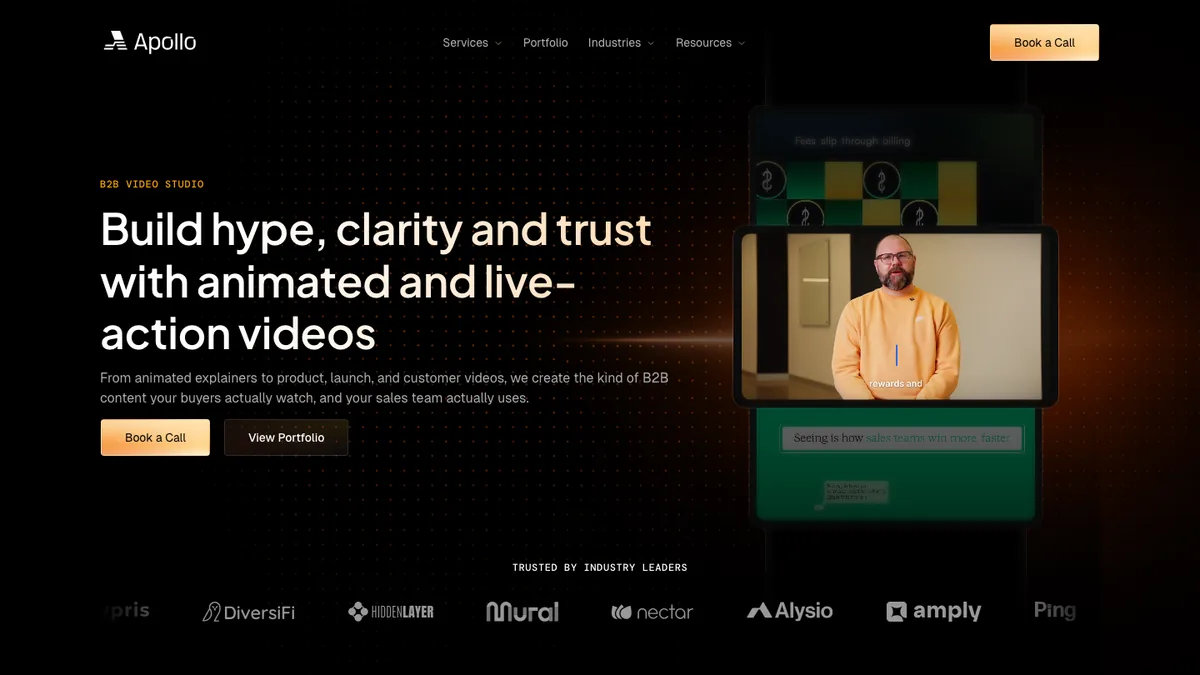
Best for: B2B startups whose product has to be explained before it can be sold.
Apollo Studio works only with B2B tech companies, across SaaS, AI, fintech, cybersecurity and healthcare, and it ranks first on a list built around comprehension because that narrowness is the whole proposition. The studio's own framing is that a video should do the explaining the sales team currently does by hand, which is precisely the problem a startup with a new category has.
The roster reads like a startup portfolio. Apollo Studio produced launch videos for Artra and Alysio, a product tour and a launch film for Ping, and product explainers for Redo, Mindsmith, Cypris AI and Markopolo AI, alongside work for Mural, Awardco and Anvilogic. Those are companies that needed a first video to establish what they do, not a refresh of a known brand.
Two things make it fit the startup calendar. Motion design is produced in-house, so animated product sequences and live-action founder footage come from one team rather than a studio plus a subcontractor. And the turnaround is fast for the category: post-production in about a week, full productions in about three. Project pricing starts at $10,000, and co-founder Cade Biegel runs the strategy calls directly.
Who it's less suited for: Better suited to B2B startups launching or explaining a product than to consumer apps, or to teams that want a high volume of short social videos every week. If you need eight talking-head clips a month, a subscription video team is built for that cadence.
2. Vidico
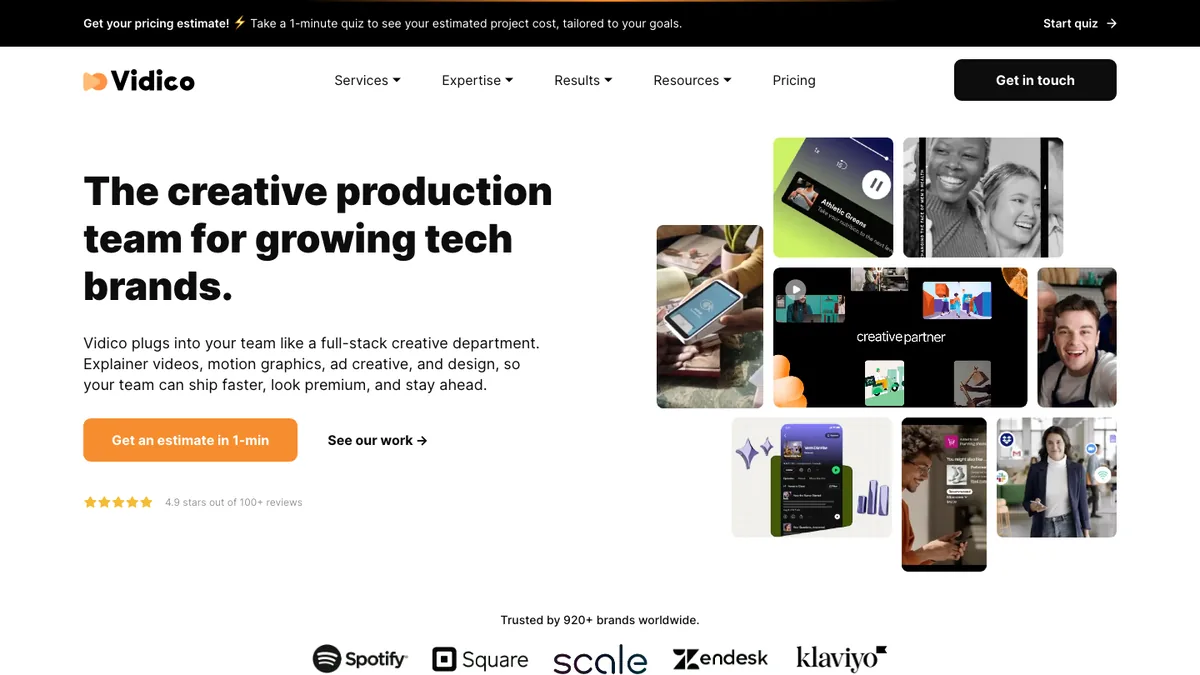
Best for: Startups that need one shoot to produce a whole library.
Vidico runs a dedicated startup practice covering pitch, explainer, demo and launch videos, and its argument is arithmetic. Each production is planned to yield more than 40 assets across channels, including social cuts, ad variations, GIFs and banners, so the cost of the shoot is spread across everything a launch needs rather than one film.
The startup client list is long and current: Airtable, Buffer, DigitalOcean, HoneyBook, Algolia, Cascade, EverString and a run of Y Combinator alumni. Vidico reports that HoneyBook lifted waitlist sign-ups by 9% and that Unhedged raised $2.3 million with a crowdfunding video, which are the company's own figures but the right kind of figure to be publishing.
Subscription plans start around $5,000 per month and cover strategy, scripting, production and edits under one fee. Timelines run six to eight weeks including feedback rounds for a first animated or live-action piece, with subsequent videos shipping faster once the system is set up.
Who it's less suited for: Better suited to teams producing continuously across channels than to those needing one piece quickly. If you have a launch in five weeks and nothing after it, a project studio with a shorter cycle is the better call.
3. Sandwich
Best for: A launch film that becomes part of the company's story.
Sandwich, founded by Adam Lisagor in Los Angeles, effectively invented the modern startup launch video: the founder in a well-lit office, explaining the product with self-aware humour, in a format that has been copied so widely it now reads as a genre. Slack's early identity was shaped by it, and the current roster includes Perplexity, Gamma, Descript, Brex, Postman, Rubrik, Square, Airbnb and Instacart.
The reason it ranks high on a comprehension-first list is that the writing is the product. Sandwich's own line is that your product is complex and they make it seem simple, and the work delivers on it because the comic timing is doing the explanatory work rather than decorating a voiceover. Very few studios can write that way, and for a startup whose category needs establishing, a film people actually share is worth more than a film people merely watch.
Pricing is not published. Reported figures put serious Sandwich projects well into six figures, which is why it sits at three rather than one on a list that weights price fit.
Who it's less suited for: Better suited to well-funded launches with a founder willing to be on camera than to seed-stage budgets or teams that want to stay behind the product. If your budget is a fraction of that, several companies below will get you a strong launch film for a tenth of the cost.
4. Videodeck
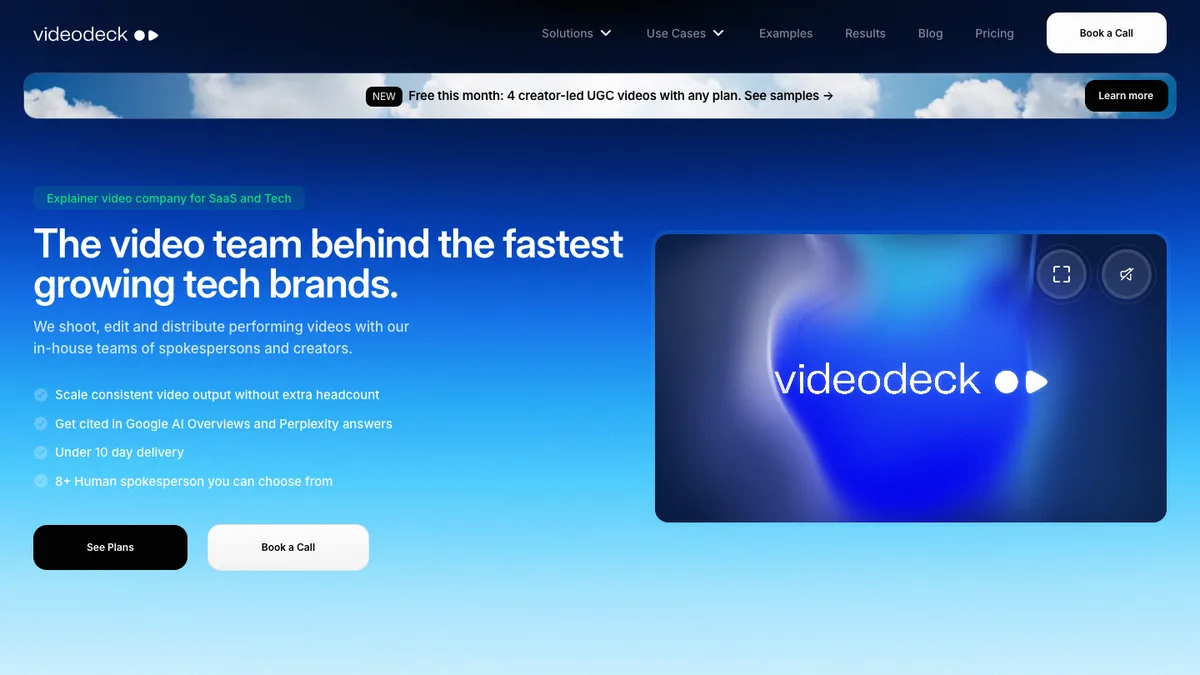
Best for: Startups that need videos every month, not one video this quarter.
Videodeck is built around a delivery commitment most studios won't make: under ten days from brief to finished video. It works exclusively with SaaS and tech companies, reports more than 100 software clients across martech, AI, fintech, developer tools and productivity, and runs in-house spokespersons, cinematographers, editors and designers so a startup with no one comfortable on camera can still ship presenter-led content.
It's also one of the most transparent companies on this list about money. A single video is $5,000 as a one-off project, packs of five and ten come down to $3,500 and $3,000 per video, and monthly plans run from $2,500 per video at four videos a month to $2,000 per video at twelve. For a startup trying to model content spend before a round closes, having the numbers on the website is a real advantage.
The format skews toward explainer, demo and presenter-led content that performs in feeds and search rather than cinematic brand film, which is the correct trade-off for most early-stage teams.
Who it's less suited for: Better suited to steady, fast, performance-oriented output than to a single high-production hero film. If the launch video has to carry a keynote, a studio built around one ambitious piece will take it further.
5. Represent Studio
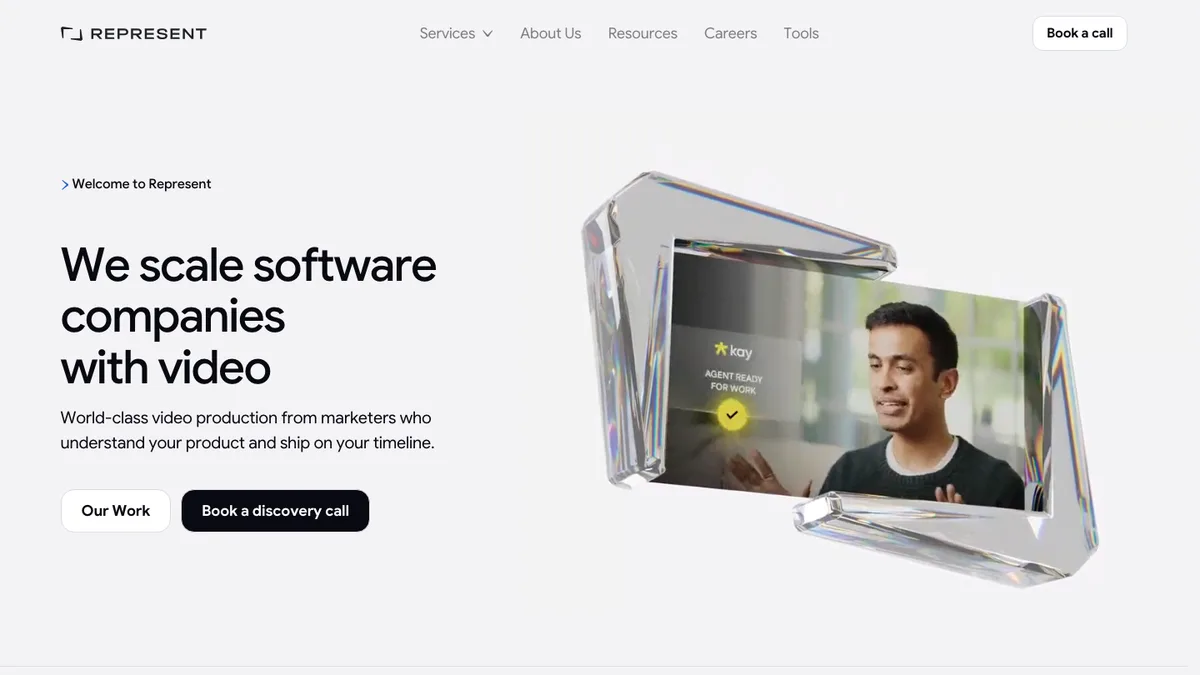
Best for: Venture-backed AI and developer tool companies.
Represent Studio works with software companies, and its client list is unusually current for this category: Dataiku, Otter, Lindy AI, E2B, Factory AI and FirstMark. Launch videos, product tutorials, customer testimonials and long-form YouTube are all named service lines, which maps closely to what a technical startup needs in its first two years.
The fit is specific. AI and developer tool companies have a particular explanation problem, in that the product's value is often invisible on screen and the buyer is frequently an engineer who will switch off at the first vague sentence. A studio working continuously with that buyer arrives understanding it. The stated figures, more than 300,000 activated users and over $1 billion raised by customers, describe the client base rather than the work, but they tell you accurately who this studio serves.
Pricing is by quote.
Who it's less suited for: Better suited to technical, venture-backed teams moving quickly than to non-technical products or enterprise buyers working through formal procurement. If your product sells on emotion more than on mechanism, a broader creative studio will fit the brief better.
6. LV Productions
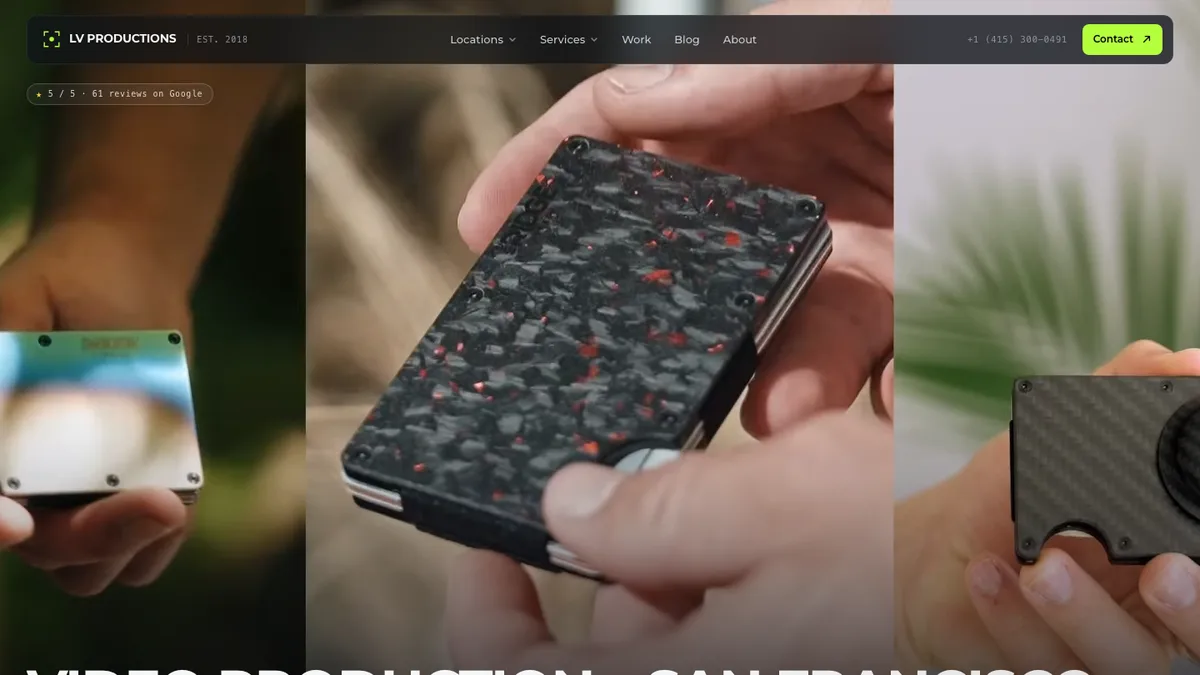
Best for: Live-action production with the price range on the website.
LV Productions is a San Francisco studio, established in 2018 with additional offices in New York, Los Angeles, Miami, Austin and Las Vegas, and its client list runs straight through the Bay Area startup ecosystem: Y Combinator, Notion, Webflow, Together AI, Copy.ai, Freshpaint, Tabby and Ridge. It carries 61 Google reviews at a five-star average, which is a stronger public review record than most studios here.
What earns it a place on a startup list is the published pricing. The site gives working figures: around $6,000 for a straightforward corporate edit, around $15,000 for a testimonial package, around $30,000 for 3D animation, and $80,000 and up for a TV spot or major launch, with the overall range stated as $5,000 to $100,000 and more depending on scope. Turnaround is equally specific: a first cut within a week of wrap, a single spot from kick-off to final master in two to four weeks, and rush delivery in 48 to 72 hours from wrap when needed.
The centre of gravity is live action, from founder films and product shoots to event coverage, with animation and 3D available alongside.
Who it's less suited for: Better suited to founder-led and product film than to animation-only briefs. If your product has no interface worth filming and the whole video needs to be built in motion design, an animation-first studio is the more direct route.
7. Wyzowl
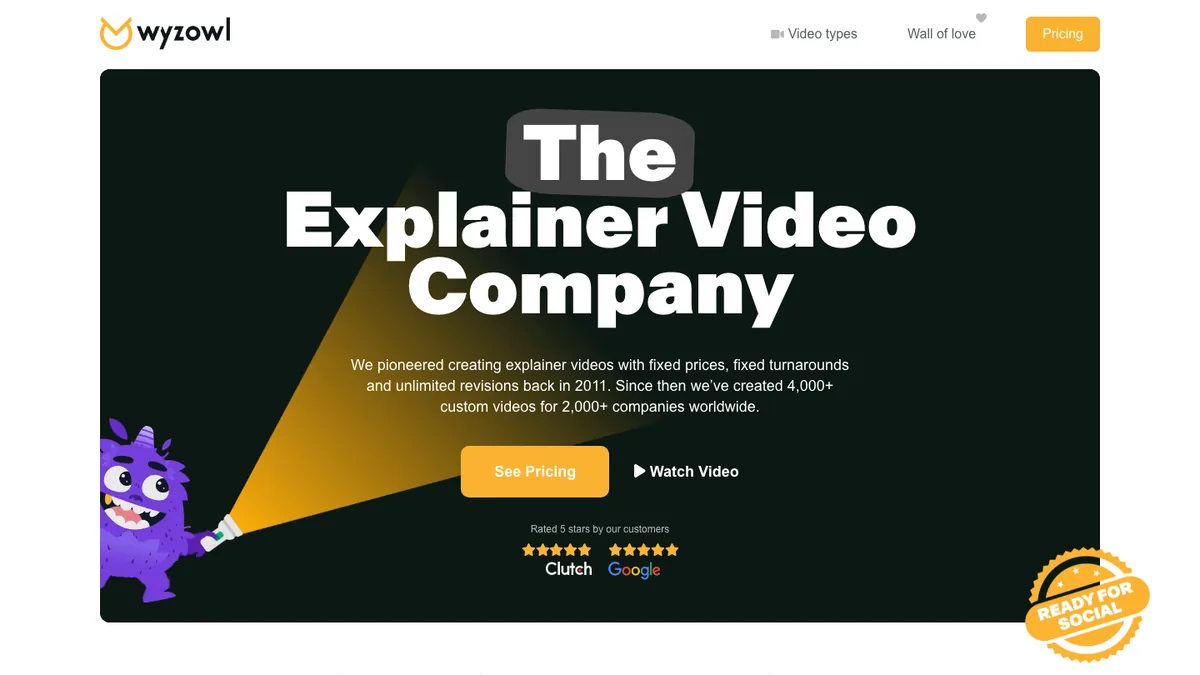
Best for: A fixed-price explainer with no surprises.
Wyzowl pioneered fixed-price explainer production in 2011 and reports more than 4,000 videos for over 2,000 companies across 40 countries, with clients including Amazon, PayPal, Slack, HSBC and Deloitte. Packages run roughly $2,500 to $9,000, and the price and scope are known before the first call.
For a seed-stage team that needs a competent explainer live without a procurement cycle or a surprise invoice, that certainty is worth more than it sounds. At seed stage the real risk isn't that the video is merely good rather than exceptional. It's that a project overruns by six weeks and two budget revisions while you're trying to launch. Wyzowl's scale means the process is heavily systematised, and systematised processes are the ones that hold when your side of the project slips.
The volume also means the team has explained a very large number of software products, so the scripting rarely starts from zero.
Who it's less suited for: Better suited to teams valuing predictable scope than to those wanting bespoke creative. Fixed packages are built for repeatable quality, so an unusual narrative approach or a distinctive visual language will strain the model.
8. Motion The Agency
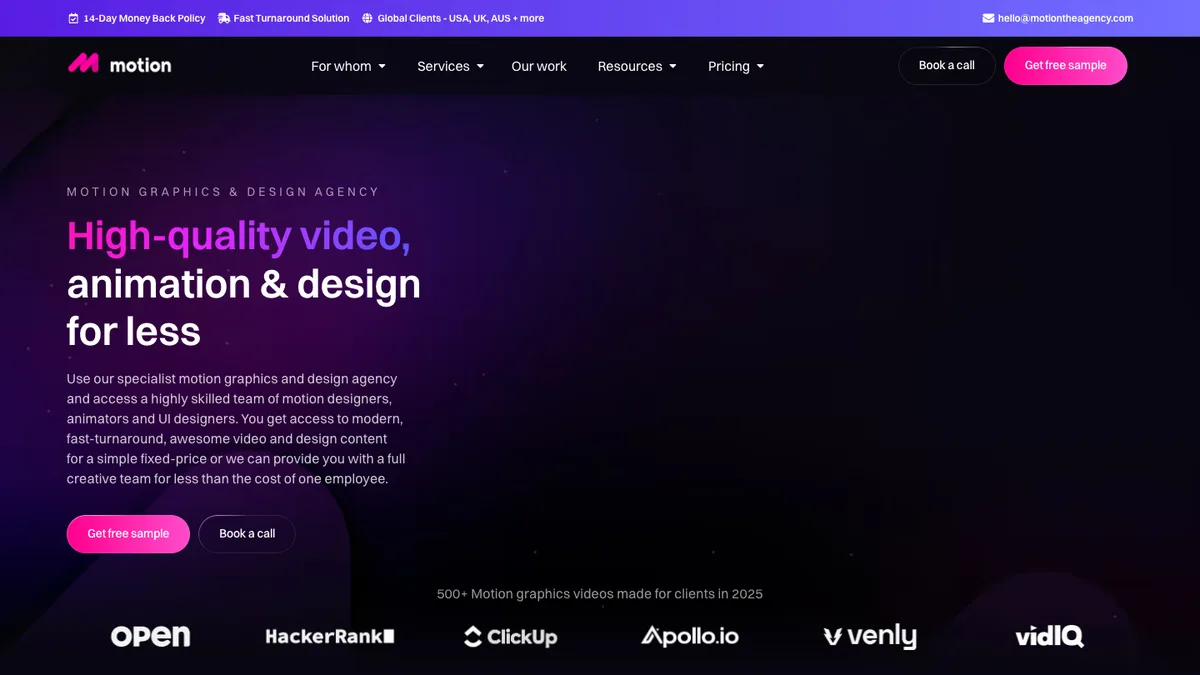
Best for: Animated product and feature videos at a per-video price under $4,000.
Motion The Agency is a London-registered motion graphics and design studio that explicitly serves startup and scale-up segments, with Y Combinator-backed companies on the roster and clients including HackerRank, ClickUp, Attio, Bonsai and VidIQ. It reports more than 500 motion graphics videos produced for clients in 2025.
The pricing is the reason it's here. Fixed-price videos start from $3,480, subscriptions from $3,680 per month, and the pitch is an entire animation and design team for less than one employee. That framing lands with early-stage teams who are deciding between hiring a motion designer and outsourcing the function, and the fixed-price model with a published 14-day money-back policy takes most of the risk out of trying it.
The work is motion-graphics led, covering explainers, sizzle reels and UI animation, produced in After Effects, Figma and Blender, which suits software products where the interface is the story.
Who it's less suited for: Better suited to animated product and feature videos than to live-action shoots with a founder or customer on camera. If the brief needs real people, a production company with crews is the right tool.
9. Demo Duck
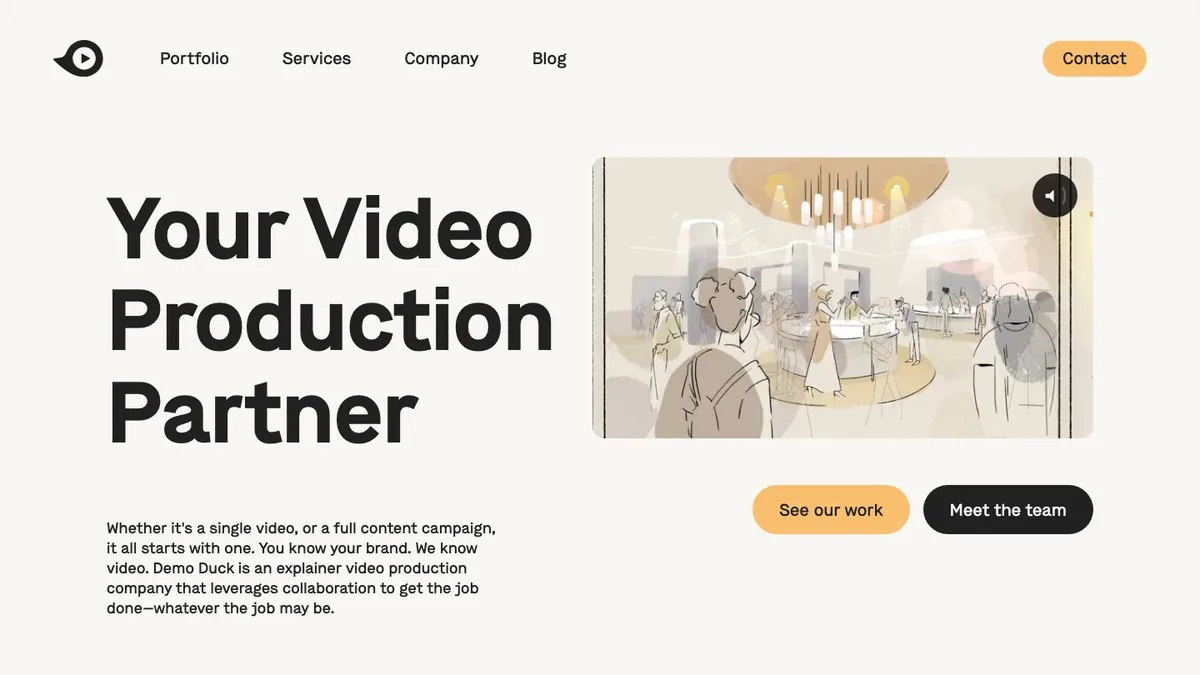
Best for: A flagship piece with genuine creative range.
Demo Duck is a Chicago studio with work for Netflix, Google and Geico, and real range across animation, live action and mixed media. For a startup whose category is crowded and whose actual problem is sounding like everyone else, that creative ambition is the reason to choose it.
The animation strength matters for one startup situation in particular: a product with nothing to film. When the value lives in a data flow, a model or a workflow rather than an interface, the video has to invent a visual language for something invisible, and Demo Duck's work tends to fall on the right side of the line between a metaphor that carries information and one that decorates a voiceover.
Pricing reports vary, with some sources placing projects at $8,000 to $20,000 and others reporting custom work starting nearer $25,000 with six to ten week timelines. Treat those as indicative and scope directly, since the spread most likely reflects the distance between an animated explainer and a full production.
Who it's less suited for: Better suited to teams planning a quarter ahead than to those with a launch in five weeks. If the date is fixed and close, several companies here commit to shorter cycles.
10. Content Beta
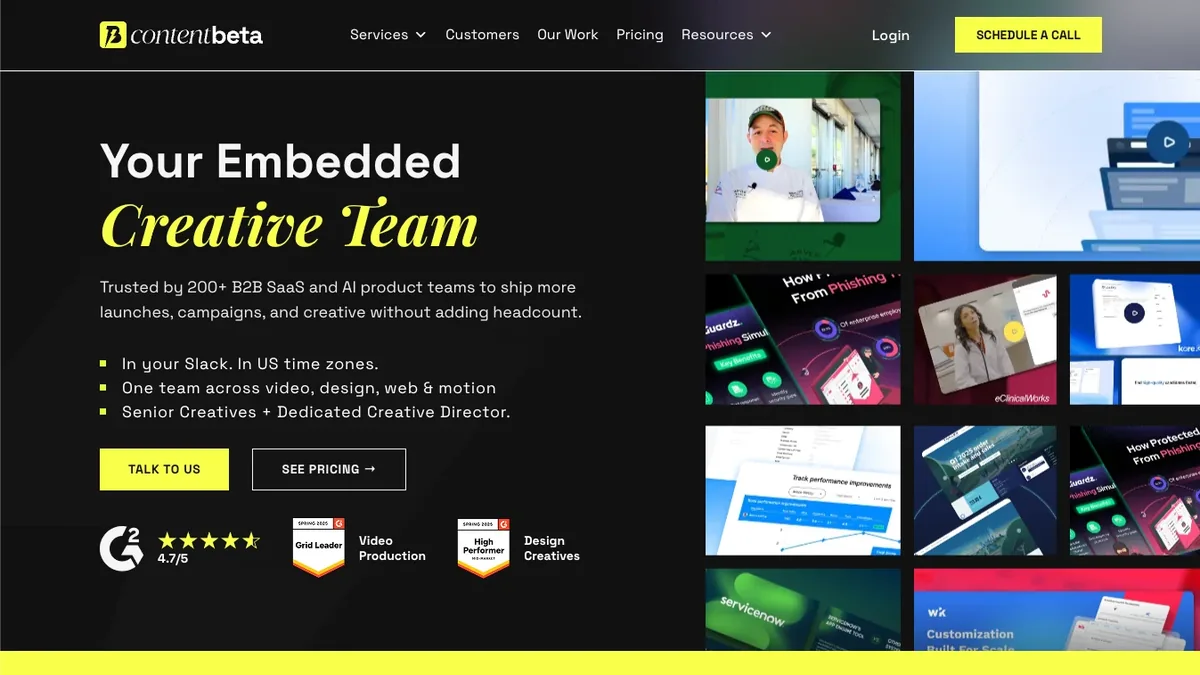
Best for: Product-led startups that ship features every month.
Content Beta runs creative-as-a-service for B2B SaaS, covering video, motion and design on subscription from around $3,000 per month. It ranks on a startup list because the model is designed for a problem product-led companies hit early: every release needs supporting creative, and there's no in-house team yet to make it.
Handling that through project agencies means permanent scoping overhead. Handling it in-house means hiring a video team before the volume justifies one. A subscription sits between the two, and per-video costs fall against agency rates once the throughput is steady. For a startup already shipping weekly, it's often the first video arrangement that actually keeps pace.
The team also publishes extensively on B2B and SaaS video, which is reasonable evidence of how seriously it takes the category.
Who it's less suited for: Better suited to steady multi-format throughput than to a single ambitious launch film. If you need one piece to carry the launch and nothing else for six months, a project studio will give it more concentrated attention.
Honorable Mentions
- Venture Videos: SaaS specialist with a published four-week delivery on launch videos, aimed at established and growing SaaS companies rather than seed-stage teams.
- Thinkmojo: San Francisco and Montreal studio that has worked with big brands back when they were startups, including Square and Calendly.
- Explainify: Animation-first explainer specialist, strong on scoping discipline for products that are genuinely hard to describe.
- XPLAI: Krakow motion design studio focused on startups and first-time founders.
- Yum Yum Videos: Story-led animation with personality, useful when a startup video has to survive a social feed.
- Superside: Subscription creative at enterprise scale, relevant once a startup has a brand team and a paid budget to feed.
Which Video Production Company Is Best For Your Startup?
Your product needs explaining before it can be sold. Apollo Studio or Represent Studio. The constraint is whether the team understands a new B2B product quickly, which is a specialisation question rather than a production one.
You're launching in five weeks. Apollo Studio, Videodeck or LV Productions, the three companies here that commit to a cycle short enough to hit it.
You need to know the price today. Wyzowl, Motion The Agency, Videodeck or LV Productions, all of which publish figures. Apollo Studio publishes a starting point of $10,000.
You have real money and a founder who can carry a film. Sandwich. Spend on the writing, because the launch film will be the thing people remember about the company.
You need eight videos a month, not one this quarter. Videodeck, Content Beta or Vidico. Buy a cadence, not a project.
Your product has no interface to show. Demo Duck or Motion The Agency. The video has to be built in motion design, and both are strong at inventing a visual language for something invisible.
You want one shoot to feed six months of paid social. Vidico. The 40-plus-assets-per-shoot model is designed for exactly that.
You're seed-stage and every dollar is counted. Wyzowl or Motion The Agency. Fixed price, known scope, no overruns.
Launch Video, Explainer or Pitch Video: Which Should a Startup Make First?
Startups often brief all three at once, and the result is usually one video that does none of the jobs well. They're different assets with different audiences.
A launch video announces. It runs 60 to 90 seconds, it exists to make a date matter, and it's built for sharing: the founder's LinkedIn post, the Product Hunt page, the press embed. It should create a feeling about the company more than it should walk through features, because at launch nobody is evaluating features yet.
An explainer teaches. It runs 90 seconds to two minutes, it lives on the homepage and in outbound, and its job is comprehension. A viewer who didn't understand the category at the start should understand it, and your product's place in it, by the end. This is the asset with the longest shelf life and the one most startups should make first, because it keeps working after launch day.
A pitch video persuades one room. It's the two-minute piece in the investor deck or the accelerator application, and it needs to state the problem, the wedge and the traction in a way a partner can forward to another partner. It is rarely the same cut as the explainer, because the buyer of the product and the buyer of the equity care about different things.
The efficient way to commission them is as one production with three edits, which is why reusability is one of our five criteria. A shoot planned for it can produce a launch cut, an explainer cut and a pitch cut from largely the same material. A shoot planned for a single film produces one film, and the other two get commissioned separately six months later at full price.
If you can only make one, make the explainer, then cut a shorter launch version from it.
How Much Does Startup Video Production Cost in 2026?
Startup video is more transparent on price than most categories, because several of the companies that serve startups publish their figures. The bands below use published numbers where they exist and attributed ranges where they don't.
- $2,500 to $9,000 per video: Fixed-price animated explainers. Wyzowl's published package range, and the clearest benchmark for a competent explainer with known scope.
- From $3,480 per video: Motion The Agency's published fixed-price starting point for motion graphics work, with subscriptions from $3,680 per month.
- $3,000 to $5,000 per video: Videodeck's published one-off pricing, from $5,000 for a single video down to $3,000 per video in a pack of ten. Monthly plans run $2,000 to $2,500 per video.
- $3,000 to $5,000 per month: Subscription creative covering video alongside motion and design. Content Beta publishes from around $3,000, Vidico from around $5,000.
- $6,000 to $30,000 per project: LV Productions' published working figures: around $6,000 for a straightforward corporate edit, around $15,000 for a testimonial package, around $30,000 for 3D animation.
- From $10,000: Apollo Studio's published starting point for project work.
- $8,000 to $25,000 and up: Demo Duck's reported range for custom explainers and brand pieces, depending on format.
- $80,000 and above: A major launch spot with a full crew, per LV Productions' published upper band. Reported Sandwich projects sit in this territory and beyond.
The useful comparison is between the second and the last band. A fixed-price animated explainer and a six-figure launch film are both "a startup video", and the gap between them is not mainly quality. It's format, crew size, and how much of the company's story the film is expected to carry. Decide which job the video has before you decide what it should cost.
Factors That Influence Startup Video Pricing
Live action versus animation. Live action means a crew, a location, a day of the founder's time and travel if the team is distributed. Animation means none of that, but more time in design and iteration. Neither is inherently cheaper at the top end, but at the entry level animation has more fixed-price options.
Turnaround. Companies that commit to short cycles either systematise heavily, which keeps cost down, or charge for rush. Ask which one you're getting.
Number of edits from one production. A launch cut, an explainer cut, a pitch cut and social cutdowns from one shoot cost more than a single edit, but far less than commissioning four videos separately.
Who's on camera. Founder-led film needs no talent budget but does need the founder's time and a director who can get a natural performance from someone who has never done this. Presenter-led content from a studio with in-house spokespersons removes that variable at a cost.
Scripting and strategy. The cheapest videos assume you arrive with a script. The ones that suit a new category include the work of figuring out what to say, which is usually where a startup needs the most help.
Project versus subscription. Subscriptions cost less per video at volume and more per video if you only need one. Model your first twelve months honestly before choosing.
Final Thoughts
The mistake startups make when hiring a video company is choosing on the showreel. Every reel on this page looks good, and none of them tell you whether the studio can explain your product.
Judge the explanation instead. Watch a full piece from each company you're considering and ask whether you understood what the product does and why it matters by the end, without already knowing. If the answer is no, the studio made something beautiful for a viewer who was already sold, and that's not the viewer a startup has.
Then be honest about your constraint. If it's the date, buy speed. If it's the budget, buy a fixed price. If it's the product being genuinely hard to explain, buy comprehension, and accept that it usually costs a little more than a template. Very few companies are best at all three, and the ones that say they are tend to be talking about the showreel.
Related Articles
Frequently Asked Questions
Most startup videos cost between $2,500 and $30,000 in 2026, based on published figures from the companies that serve startups. Fixed-price animated explainers run $2,500 to $9,000 at Wyzowl and from $3,480 at Motion The Agency. Videodeck publishes $5,000 for a single video, falling to $3,000 per video in packs of ten. Apollo Studio starts at $10,000 for project work, and LV Productions publishes $6,000 to $30,000 for most project types, rising to $80,000 and up for a major launch spot. Subscription video from Content Beta or Vidico starts around $3,000 to $5,000 per month.
An explainer, in most cases. It has the longest shelf life, it lives on the homepage and in outbound, and a shorter launch cut can be made from it. A launch video on its own stops being useful the week after launch. A pitch video is a separate edit aimed at investors and rarely doubles as marketing.
Two to eight weeks depending on the company and format. Videodeck delivers in under ten days, Apollo Studio completes full productions in about three weeks, LV Productions quotes two to four weeks per spot, and Vidico and Demo Duck run six to ten weeks for a first animated or live-action piece. Your own review turnaround is usually the biggest variable.
Use an agency until you're producing several videos a month, then reconsider. A single in-house video producer costs more than most agency projects and can't cover scripting, animation, filming and editing alone. Subscription video teams such as Content Beta, Videodeck or Motion The Agency sit between the two options and are usually the first arrangement that keeps pace with a product-led company.
Yes if it's built from the same production as the explainer, and usually not if it's a separate six-figure commission. At seed stage the video's job is to make the product understood by early customers and investors, and a well-made explainer with a short launch cut does that for a fraction of the cost of a standalone launch film.
Yes, and it often should be. Software interfaces change quickly, and an animated or motion-graphics treatment can show the workflow without dating as fast as a screen recording. Motion-led studios such as Motion The Agency, Wyzowl and Demo Duck specialise in this, and Apollo Studio produces motion design in-house alongside live action.
Lead with the problem, not the product. Explain who has the problem, what they do about it today, and what changes with your product, in that order. Share the sales deck, three customer calls if you have them, and the one sentence you'd want a viewer to repeat. Companies that work continuously with B2B startups, such as Apollo Studio, Represent Studio or Vidico, will do much of this structuring for you.
No, but it helps at launch. Founder-led film is the format Sandwich made famous, and it works because early customers and investors are buying the team as much as the product. If the founder isn't comfortable on camera, presenter-led content from a studio with in-house spokespersons, such as Videodeck, or a fully animated explainer, both avoid the problem.
A production company writes, films or animates, and edits a bespoke video for you. A platform is software that generates or assembles videos from templates, scripts or documents. Platforms are cheap and fast and suit internal or high-volume content. For a launch or explainer that has to establish a new category, the scripting and editorial judgement come from a production company.
Track completion rate first, then conversion on the pages where it sits against the same page without it. Downstream, watch whether investors and prospects reference it unprompted, and whether the sales team sends it without being asked. Reps drop assets that don't help.
Explore Our Blog Posts
Discover insightful articles on cybersecurity and more.

Best Video Agencies for Developer Tools Companies (2026)
How to Choose a B2B Video Production Agency (2026 Guide)