Comparing Best Webflow Agencies for Enterprise Website Redesign (2026)

.png)
Key Takeaways
- Enterprise website redesigns are about managing risk, not just improving visuals.
- Not all Webflow agencies are equipped to handle enterprise-level complexity.
- Governance, CMS structure, and post-launch ownership matter more at scale than speed.
- Strong enterprise agencies design for long-term operability, not one-time launches.
- Webflow can support enterprise websites when architecture and processes are handled correctly.
- Process maturity and stakeholder alignment are critical for large organisations.
- Choosing an agency based on reputation alone often leads to operational friction later.
- The right partner reduces internal complexity and supports multiple teams after launch.
Redesigning an enterprise website is rarely about aesthetics. It’s about risk.
For large organisations, a website redesign can affect search visibility, lead flow, governance, compliance, and how multiple teams operate day to day. When the site sits at the centre of marketing, sales, and brand, the margin for error is small and the cost of the wrong decision is high.
This is where platform choice and agency capability intersect. While Webflow has become a serious contender for enterprise websites, executing redesigns at scale requires a delivery model built for governance, performance, and long-term ownership, particularly for enterprise-level Webflow solutions operating inside complex organisations.
The challenge for enterprise teams isn’t finding agencies that use Webflow. It’s identifying partners that understand governance, long-term scalability, and the realities of large, distributed organisations.
This list focuses on Webflow agencies with proven experience in enterprise website redesigns, agencies that can manage complexity without sacrificing performance, clarity, or control.
Already looking to hire a Webflow agency?
If you’re past the comparison stage and want a dedicated partner for enterprise website redesign, see how Amply approaches enterprise webflow projects
How We Selected These Agencies
Enterprise teams don’t need more agency options, they need better filters.
Most Webflow agency roundups blur the line between studios built for speed and partners equipped for scale. For enterprise website redesigns, that distinction matters. Governance, performance, content operations, and stakeholder alignment aren’t edge cases, they’re the default.
We evaluated agencies based on how they operate inside real enterprise constraints, where process maturity, long-term usability, and the ability to evolve an existing website safely matter as much as design quality. Enterprise redesigns rarely start from zero; they involve reworking established structures and systems without disrupting how teams already rely on the site.
That’s why strong redesigns are grounded in solid design fundamentals. If you want a deeper view into how enterprise website design is approached at a foundational level beyond the mechanics of redesign execution, this overview of enterprise website design provides useful context around structure, governance, and long-term usability.
Our Selection Criteria
- Enterprise-ready Webflow experience
We prioritised agencies with proven experience delivering complex, high-traffic Webflow websites for enterprise or upper mid-market organisations. Familiarity with large teams, layered approvals, and long-term ownership mattered more than speed or volume of launches. - Ability to manage complexity at scale
Enterprise redesigns introduce technical and organisational challenges. Agencies were evaluated on their ability to design scalable CMS structures, manage SEO-sensitive redesigns, and support integrations with broader marketing and analytics systems. - Process maturity and governance
Strong delivery processes were essential. Preference was given to agencies that demonstrate clear discovery, planning, QA, and launch governance, along with structured handover and post-launch support models. - Deep Webflow expertise
This list focuses on agencies where Webflow is a core platform, not an occasional offering. We looked for evidence of advanced Webflow usage and a clear understanding of its capabilities and limitations in enterprise contexts. - Verifiable enterprise work
Only agencies with public case studies or clearly documented enterprise or large-scale Webflow projects were considered. Each inclusion is backed by real-world work that demonstrates how their approach holds up beyond launch.
Best Webflow Agencies for Enterprise Website Redesign
Enterprise teams don’t need more agency options, they need fewer, better ones. When a website supports multiple teams, regions, and long sales cycles, the ability to deliver at scale matters more than name recognition or visual polish.
This list focuses on Webflow agencies with proven experience handling enterprise-level complexity. Each agency is evaluated using the same criteria and follows the same structure to make comparison easier.
1. Amply

Amply is a Webflow-focused web design agency that works with B2B and enterprise teams to redesign complex marketing websites built for clarity, scale, and long-term usability.
Their work centres on helping organisations translate complex offerings into clear, structured website experiences that support demand generation, sales enablement, and brand credibility. Rather than treating an enterprise redesign as a visual refresh, Amply approaches it as a systems project, aligning information architecture, messaging, and CMS structure so multiple teams can operate the site confidently after launch.
Amply typically partners with organisations that need governance-ready Webflow builds, scalable page systems, and SEO-conscious architectures that can evolve over time without constant redevelopment or platform friction.
What Amply focuses on:
- Enterprise and B2B website redesigns on Webflow
- Information architecture and structured CMS systems
- Messaging clarity for complex products and services
- Scalable, governance-ready Webflow builds designed for long-term ownership
Best fit for:
- Enterprise and upper mid-market B2B organisations
- Teams managing complex offerings and long sales cycles
- Marketing teams that need clarity, control, and scalability across stakeholders
2. Finsweet

Finsweet is a Webflow-focused development agency known for building highly technical, scalable websites for teams with advanced requirements. Their work is rooted in solving structural and performance challenges on Webflow, particularly for large sites that demand precision, consistency, and long-term maintainability.
Rather than leading with visual design, Finsweet’s approach is engineering-led. They are widely recognised for creating frameworks, tools, and methodologies that push Webflow beyond standard use cases, making them a strong option for enterprise teams with complex CMS needs, large content volumes, or strict technical constraints.
What Finsweet focuses on:
- Advanced Webflow development and custom CMS architectures
- Scalable frameworks for large, content-heavy websites
- Performance optimisation and technical reliability at scale
- Custom tooling and systems that extend Webflow’s core capabilities
Best fit for:
- Enterprise teams with complex or content-heavy Webflow builds
- Organisations prioritising technical robustness and scalability over visual exploration
- Teams with in-house design or strategy resources that need deep Webflow engineering support
3. Flowout
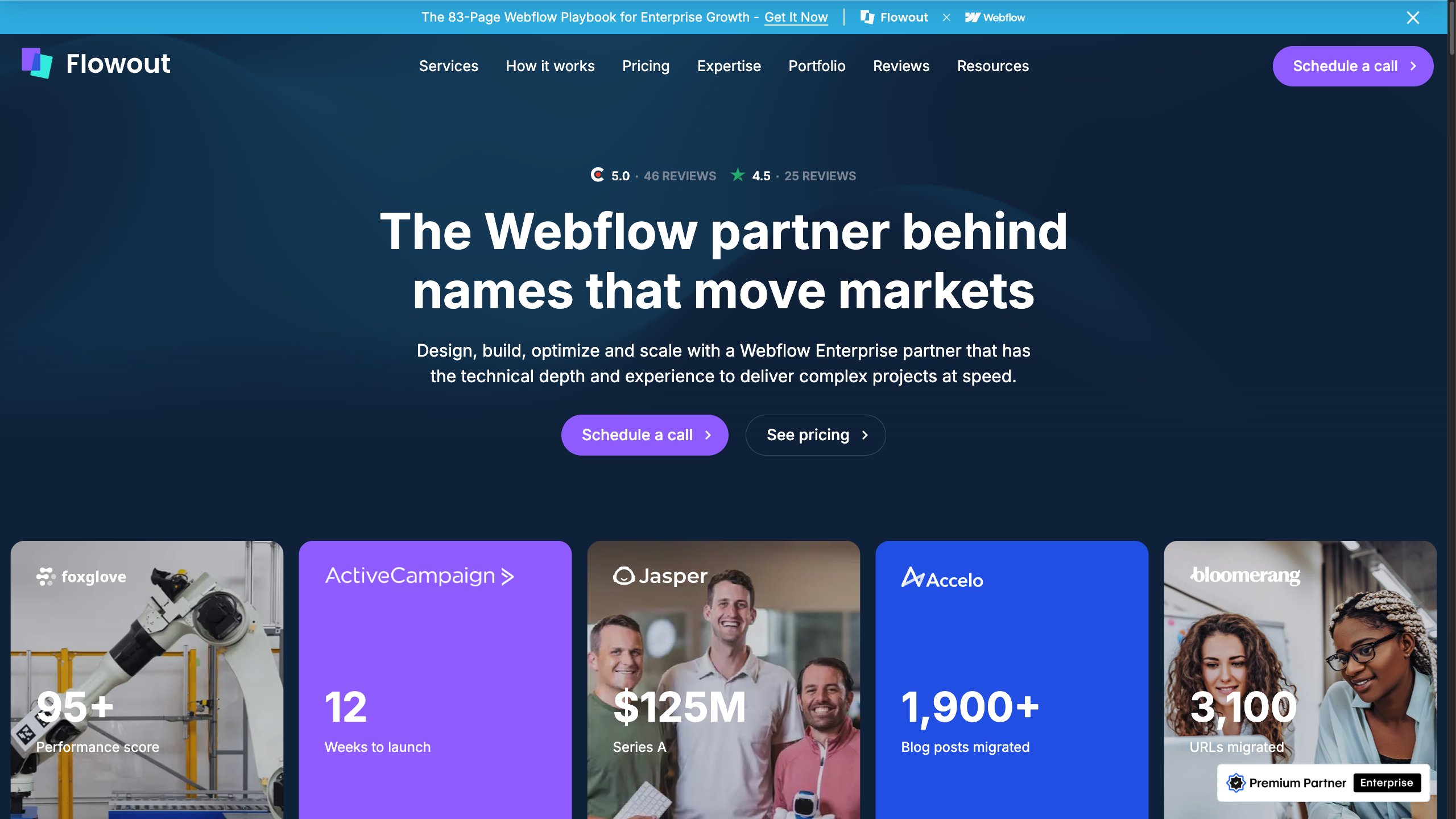
Flowout is a Webflow Enterprise Partner that works with B2B and enterprise organisations on marketing website redesigns, migrations, and long-term Webflow support. Their approach focuses on structured delivery, scalable CMS architecture, and building websites that internal teams can operate and expand independently after launch.
Flowout's enterprise experience includes large-scale WordPress to Webflow migrations involving complex content systems, full redirect mapping, and multi-stakeholder delivery processes. Their work is designed to reduce post-launch dependency rather than create it.
What Flowout focuses on:
- Enterprise Webflow redesigns and WordPress migrations at scale
- Scalable CMS systems and structured content architecture
- SEO-conscious migrations with full 301 redirect mapping
- Long-term Webflow support and ongoing website optimisation
Best fit for:
- Enterprise and B2B organisations migrating off legacy WordPress or HubSpot builds
- Marketing teams that need governance-ready Webflow systems and internal content ownership
- Organisations managing complex redesigns with multiple stakeholders and phased delivery
4. Creative Mules
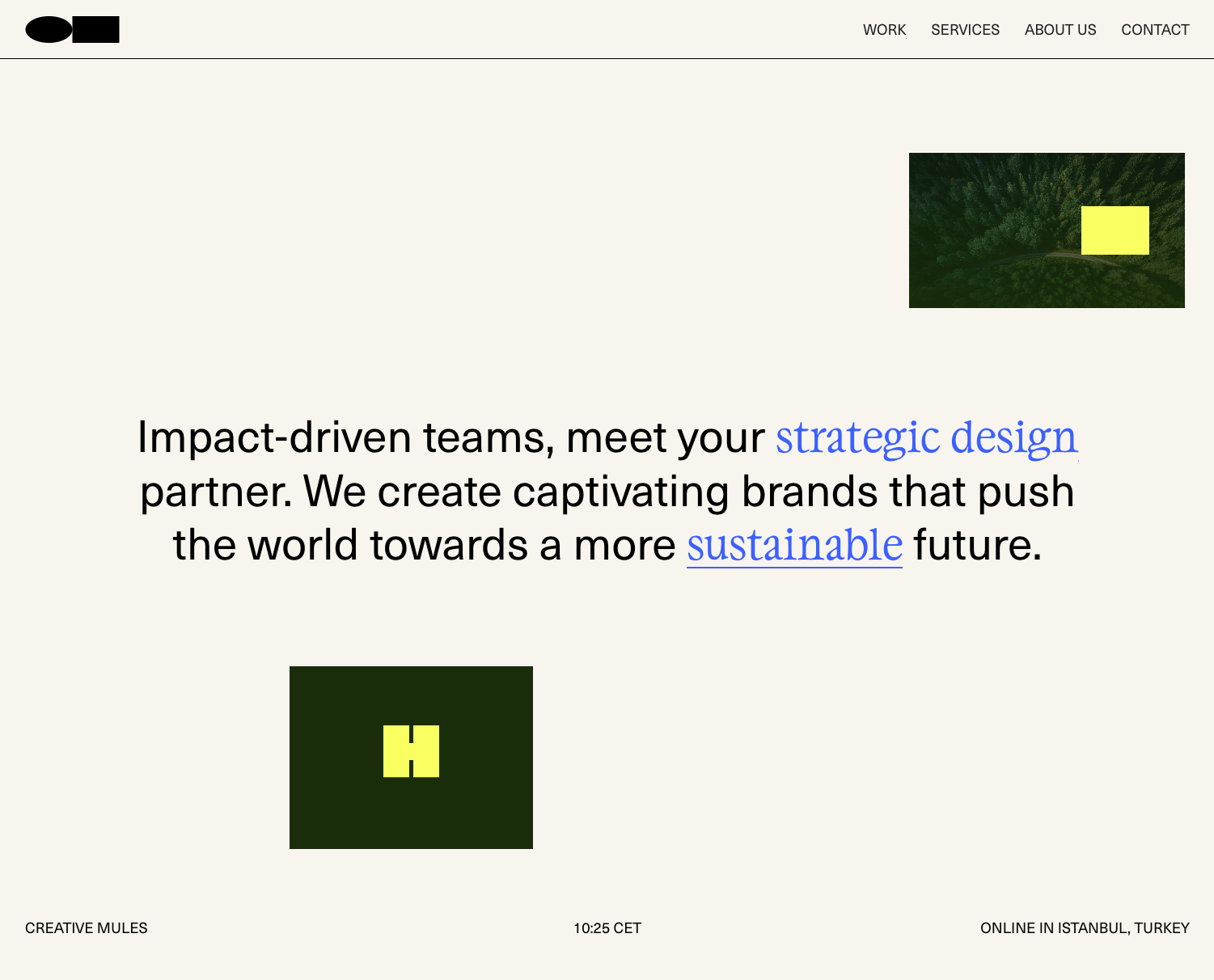
Creative Mules is a Webflow agency that helps enterprise and B2B organizations redesign websites with scalability and usability in mind. Their work emphasizes clear information architecture, maintainable CMS structures, and development practices that support ongoing growth after launch.
Rather than building websites that become difficult to manage over time, Creative Mules focuses on creating systems that allow marketing teams to operate independently and scale content efficiently.
What Creative Mules focuses on:
- Enterprise Webflow redesigns
- Scalable CMS and content systems
- Structured information architecture
- Long-term maintainability and governance
Best fit for:
- Organizations planning significant content growth
- Enterprise marketing teams managing websites internally
- Companies prioritizing scalability and ease of use
View Creative Mules' portfolio
5. MakeBuild

MakeBuild is a Webflow agency that partners with SaaS and technology companies on enterprise website redesign projects. Their work combines strategy, user experience, and technical implementation to help businesses create websites that better support marketing, sales, and customer acquisition goals.
Rather than focusing only on visual improvements, MakeBuild approaches redesigns as business initiatives that should improve communication, conversion, and overall website effectiveness.
What MakeBuild focuses on:
- Enterprise website redesigns
- SaaS and technology-focused Webflow development
- User experience and conversion optimization
- Growth-oriented website strategy
Best fit for:
- SaaS and technology enterprises
- Organizations aligning website redesigns with growth goals
- Teams seeking a strategic redesign partner
6. Hello Monday

Hello Monday is a global design agency known for its brand-led approach to digital experiences, working with enterprise organisations to translate brand strategy into cohesive, large-scale website experiences. Their Webflow work often sits within broader brand or identity programmes, where consistency, expression, and clarity across touchpoints are critical.
For enterprise website redesigns, Hello Monday brings a strong strategic and creative lens, focusing on how brand systems are expressed through structure, layout, and interaction. Their projects typically prioritise narrative, visual coherence, and long-term brand alignment, making them a strong fit when a redesign is part of a wider brand evolution.
What Hello Monday focuses on:
- Brand-led enterprise website redesigns
- Translating brand strategy into digital systems
- Visual storytelling and experience design at scale
- Cohesive design systems applied across large websites
Best fit for:
- Enterprise organisations undergoing brand or identity evolution
- Teams where brand consistency and expression are key drivers
- Companies aligning website redesigns with broader brand strategy initiatives
7. Clay

Clay is a branding and digital agency that works with enterprise and technology-led organisations to design websites that align brand, product, and marketing into a cohesive digital presence. Their Webflow work is often part of broader brand or product positioning initiatives, where clarity, consistency, and differentiation are central goals.
For enterprise website redesigns, Clay brings a strong strategic and design foundation, focusing on how complex products and platforms are communicated through structure, narrative, and visual systems. Their projects typically emphasise clear positioning, refined UI patterns, and cohesive design systems that can scale across large websites and multiple touchpoints.
What Clay focuses on:
- Brand-led enterprise website redesigns
- Positioning and storytelling for complex products
- Design systems and UI patterns built for scale
- High-fidelity Webflow execution aligned with brand strategy
Best fit for:
- Enterprise and technology companies with complex products or platforms
- Teams prioritising brand clarity and differentiation alongside redesigns
- Organisations aligning website redesigns with broader brand or product strategy
How to Choose the Right Webflow Agency for an Enterprise Website Redesign
Enterprise website redesigns succeed or fail based on fit, not credentials.
Agencies may appear equally strong on the surface, but differences in process maturity, governance thinking, and post-launch ownership become critical once real organisational constraints are introduced. Choosing well means understanding how an agency works under pressure, not just how they present their work.
This section is designed to help you translate the list into a clear, confident decision.
1. Prioritise enterprise-ready processes over creative promise
Many agencies showcase strong creative work, but enterprise redesigns succeed or fail based on process maturity. Large organisations require clear discovery phases, stakeholder alignment, governance, QA, and launch controls.
A good enterprise Webflow agency should be able to explain how they handle approvals, cross-team coordination, and risk management not just how they design pages. If their process assumes fast sign-offs, minimal stakeholders, or loosely defined ownership, that can become a liability at scale.
2. Evaluate how they think about structure and governance, not just pages
At the enterprise level, website issues are rarely visual. They’re structural.
Ask how the agency approaches information architecture, CMS design, and content ownership. Strong partners can clearly articulate how content is organised, who manages it post-launch, and how the system scales as teams, regions, or offerings grow.
If structure and governance are treated as secondary to design, the site may look polished but quickly become difficult to manage internally.
3. Confirm their experience with enterprise marketing websites specifically
Not all large websites serve the same purpose.
Enterprise marketing websites support long sales cycles, multiple buyer personas, and internal teams like demand generation, sales, and brand. Agencies that primarily build product interfaces, internal tools, or small marketing sites may struggle to design for that complexity.
What matters is whether the agency understands how enterprise websites support pipeline, credibility, and internal workflows, not just how they’re built in Webflow.
4. Look for decision-oriented thinking, not just deliverables
Effective enterprise websites are designed around decisions, what different audiences need at different stages, how trust is built over time, and how the site supports conversations that often happen off the website.
A strong agency should be able to clearly explain how key pages support intent, how calls-to-action are handled across regions or teams, and how the website reduces friction for sales and marketing efforts. When discussions focus primarily on layouts, animations, or components, it’s often a sign that decision-making is not central to their approach.
These principles align closely with the core elements of a successful B2B website, where clarity, trust-building, and decision support matter far more than surface-level design.
5. Ask how the site is meant to operate after launch
For enterprises, launch is the beginning not the end.
The right Webflow agency designs for long-term ownership. This includes building CMS systems internal teams can manage, documenting structures clearly, and anticipating future changes without requiring constant redevelopment.
If post-launch operations, iteration, and internal handover aren’t part of the conversation, the site risks becoming fragile or dependent on external support.
6. Choose for organisational reality, not brand aspiration
It’s common for enterprise teams to default to the biggest or most well-known agency. While brand scale can be valuable, it can also introduce unnecessary complexity, cost, or rigidity if the fit isn’t right.
A better approach is to choose a partner aligned with how your organisation actually works today, your approval structures, internal capabilities, and tolerance for change. The right agency adapts to that reality, rather than forcing a model that looks impressive but slows progress.
Common Mistakes Enterprises Make When Hiring a Webflow Agency for Website Redesign
Even experienced organisations can make avoidable mistakes when selecting a Webflow agency. Most issues don’t surface immediately, they show up months after launch, when internal teams struggle to operate the site or when performance and governance start to break down. The following are some of the most common missteps enterprise teams make during the selection process.
1. Optimising for visual impact over operational reality
Strong visuals are important, but enterprise websites live or die by how well they function day to day. Agencies that prioritise animation, layout, or brand expression without equal attention to CMS structure, governance, and internal ownership often leave teams with sites that look impressive but are difficult to manage or scale.
2. Assuming all Webflow agencies can handle enterprise complexity
Webflow usage alone isn’t a signal of enterprise readiness. Many agencies excel at small or mid-sized builds but struggle with large content systems, SEO-sensitive redesigns, or multi-stakeholder workflows. Treating Webflow expertise as interchangeable often leads to underestimating the complexity of an enterprise rebuild.
3. Underestimating the importance of process and governance
Enterprise redesigns require clear processes for discovery, approvals, QA, and launch control. Agencies without mature delivery frameworks may move quickly at first but create friction once multiple teams and sign-offs are involved. Weak governance typically results in delays, rework, or unclear ownership post-launch.
4. Treating the website as a one-time project
Many enterprise teams still approach redesigns as finite initiatives. In reality, the website needs to evolve continuously as offerings, messaging, and organisational priorities change. Agencies that don’t design for post-launch iteration often leave teams dependent on ongoing external support or locked into rigid structures.
5. Choosing for brand reputation rather than fit
Well-known agencies can bring credibility, but scale alone doesn’t guarantee alignment. Some large agencies introduce unnecessary complexity, cost, or rigidity if their delivery model doesn’t match how your organisation operates. Fit matters more than visibility when long-term ownership is at stake.
6. Failing to clarify internal ownership early
Even the best agency cannot compensate for unclear internal roles. When ownership of content, approvals, and post-launch management isn’t defined upfront, redesign projects often stall or regress after launch. Strong agencies will push for clarity here, ignoring this is a shared risk.
Final Thoughts
An enterprise website redesign is a risk management decision before it is a creative one.
The agency you choose will shape how your website performs, scales, and operates long after launch, influencing governance, internal workflows, and how easily teams can adapt as priorities change. At this level, success isn’t defined by how impressive a site looks on day one, but by how reliably it supports the organisation over time.
The agencies featured in this list were selected because they demonstrate the process maturity, technical depth, and organisational awareness required for enterprise Webflow redesigns. Each brings a different strength to the table, which is why fit matters more than reputation or surface-level capability.
As you move toward a decision, prioritise partners that understand structure, governance, and post-launch ownership, not just design execution. The right agency should reduce long-term friction, protect performance, and make your website easier to operate as complexity increases.
For enterprises evaluating partners and looking for a delivery model built for scale, Amply’s enterprise-level Webflow solutions are designed to support complex redesigns with clear governance, performance safeguards, and long-term operational ownership. Their approach offers a useful reference for how enterprise Webflow projects can be planned and delivered with growth in mind.
Frequently Asked Questions
Enterprise redesigns involve far more than visual updates. They require structured CMS systems, governance models, SEO-sensitive migrations, performance optimisation, and workflows that support multiple teams and stakeholders. The focus is on long-term operability, not just launch success.
Yes. Webflow can support enterprise websites when implemented correctly. Its flexibility, CMS capabilities, and editor experience work well for large teams, but success depends heavily on architecture, governance, and how the platform is configured for scale.
Enterprise-ready agencies can clearly explain how they handle complexity. Look for evidence of large-scale CMS structures, SEO-conscious redesigns, multi-stakeholder delivery processes, and post-launch ownership models. Vague promises or portfolio-only validation are often red flags.
There’s no universal answer. Large agencies can be valuable when a Webflow redesign is part of a broader transformation programme. Specialised Webflow agencies often offer deeper platform expertise and more focused delivery. The right choice depends on organisational structure, internal capabilities, and risk tolerance.
Critical. Enterprise websites are rarely static. Content evolves, teams change, and new requirements emerge. Agencies that design for post-launch iteration, with clear CMS ownership, documentation, and scalable systems significantly reduce long-term friction and dependency.
Amply works with B2B and enterprise organisations that treat their website as a long-term growth and operational asset. Their approach focuses on structured content systems, messaging clarity, and governance-ready Webflow builds, making them a strong fit for teams managing complex offerings and long sales cycles.
In addition to startup-focused website design, Amply works with B2B teams across several adjacent areas. Their core services include B2B web design, Webflow web design and development, Webflow maintenance, and conversion rate optimisation. These services are typically used together as startups evolve their positioning, launch new pages, or scale marketing efforts.
Explore Our Blog Posts
Discover insightful articles on cybersecurity and more.
Best Video Agencies for Developer Tools Companies (2026)

How to Choose a B2B Video Production Agency (2026 Guide)